Bluechip26 event summary: when things fall apart, crypto learns to hold steady
Mirela Ciobanu
20 Nov 2026 / 10 Min Read
The Paypers was in Vienna for Bluechip26 – The Crypto Safety Conference, two days of candid discussion on how digital assets can become a safe, trusted part of the financial system. Mirela Ciobanu, Lead Editor, Banking and Fintech, shares the ideas, debates, and practical lessons she brought back for bankers, PSPs, merchants, and strategists.
When things fall apart: a Friday thought
One week has passed since Bluechip26 and, as this is a Friday read, I would like to share a slightly more reflective thought. In the days since, I have been reading When Things Fall Apart by the American Buddhist nun Pema Chödrön, and I could not help noticing how closely it echoed what I heard in Vienna. I always enjoy those moments when what I read connects with real life and helps me make sense of it.
The book is about what to do when the ground gives way beneath us. Its central idea is impermanence: everything is in constant motion, and much of our suffering comes not from change itself, but from our efforts to resist it and hold things still. Pema invites us to stop scrambling for solid ground, relax into uncertainty, and stay present when plans unravel. Endings, in her view, are also openings.
One story she retells stayed with me in particular: the Buddha meditating under the bodhi tree while the forces of Mara hurl weapons at him. As they reach him, the arrows and spears turn into flowers. What was meant to wound becomes something useful, even beautiful.
That image stayed with me in Vienna. Bluechip26 – The Crypto Safety Conference took place only days after one of the most serious incidents in the industry's history. On 29 October 2026, Binance suffered a hack of around USD 6.3 billion, widely described as the largest digital-asset heist to date. Things, quite literally, fell apart.
Yet what struck many participants, including bankers from traditional finance, was the response. Binance communicated quickly, committed to covering user losses, and, by 3 November, said it had replenished 98% of the affected assets from its own funds. Stablecoin issuers and industry partners, including Tether and Circle, froze roughly USD 2.8 billion of the stolen stablecoins. By 12 November, the US Department of Justice had obtained court authorisation to seize or restrain more than USD 1.2 billion of the stolen crypto.
Not everyone applauded. Some crypto purists asked whether censorship resistance was not supposed to be the whole point, while Bitcoin, which has no issuer able to freeze balances, stayed out of reach. But for many in the room, the incident turned into a live case study in incident response, crisis communication, and risk management. The hack itself was no gift: it exposed real vulnerabilities and caused real losses. But the response showed how cooperation and controls can contain the damage, and that is where the lesson lies.
Christian Pirkner echoed Pema’s acceptance of impermanence on the final panel, Guardrails or Handcuffs: Where Should Regulation Draw the Line? Speaking of MiCA, drafted before much of today’s crypto market had taken shape, he argued that it is impossible to write rules for things that do not exist yet. And reflecting on the Binance heist, he added that building great things means accepting they may sometimes fail.
The venue itself told a similar story of change. For two days, Vienna was an international meeting point for digital asset security, as leading representatives from banking, payments, blockchain technology, and regulation gathered at Raiffeisen Bank International (RBI). A crypto safety conference hosted by one of Central and Eastern Europe's largest banking groups: that alone says a lot about how far attitudes have shifted.
From scepticism to financial infrastructure
If impermanence is the rule, the story of digital assets is a good example of it. In 2017, JPMorgan's Jamie Dimon famously called Bitcoin a fraud and compared the craze to the Dutch tulip mania. At the time, that view was shared by much of the banking establishment.
Nearly a decade later, the conversation in an RBI auditorium sounded very different. Christian Wolf, Head of Emerging Technologies & Business Models at RBI and member of the Qivalis Supervisory Board, told The Paypers that hosting Bluechip26 sends a signal to peers in traditional finance that the bank is not afraid to team up with the crypto industry, something that would have been close to impossible ten years ago. 'Staying away would be like putting on a blindfold', he said. 'I’d rather be part of the conversation than stand outside while others make the decisions.' RBI now works across three pillars: crypto assets, tokenised assets, and, above all, digital forms of money such as stablecoins, tokenised deposits, and the digital euro.
Of course, Bitcoin and digital assets are not the same thing. But the perception has changed, and so has the purpose. Early debates centred on Bitcoin as a store of value or an alternative to the banking system. Today, the discussion is increasingly about financial infrastructure: tokenised deposits and bonds, stablecoin settlement, and distributed ledger technology (DLT) as a new rail for existing markets.
Peter Kerstens, Adviser for Technological Innovation and Digital Finance at the European Commission, put this evolution into perspective. When work on what became MiCA began in 2018, he recalled, no serious financial institution wanted anything to do with blockchains. Today, he believes DLT and tokenisation may well become the new operating system of financial markets, provided the industry gets safety right.
That condition ran through the whole event. Stablecoins and tokenised assets are steadily becoming part of the traditional financial system, but their sustainable adoption depends on verifiable security standards, transparent reserves, effective supervision, and clear accountability.
Regulation: guardrails, handcuffs, and a moving target
Regulation was the thread that connected almost every session, on both sides of the Atlantic.
MiCA delivered, but the market has moved on. According to Peter, MiCA is doing what it was designed to do: regulating crypto spot markets and stablecoins, and creating a single EU market through one passport. The EU now counts around 394 licensed crypto-asset service providers. But the transitional period has barely ended and the framework is already under review, because the market it was built for has changed. Staking, crypto lending, DeFi, and prediction markets were barely on the radar when MiCA was drafted.
Peter offered a telling example. Open any major crypto platform and the assets on screen look identical to the user, yet they may fall under three or four regulatory regimes. Some are MiCA crypto-assets, others are derivatives such as perpetual futures covered by MiFID II, others are payment services, and some lending activities may require a banking licence. Consumers neither know nor care about these legal distinctions.
If he could shape a future ‘MiCA 2’, Peter said, he would focus on two things: tokenised financial instruments, because that is where the market is heading, and a new dimension of safety. Participants also raised the question of proportionality, so that smaller players are not burdened with requirements designed for much larger institutions.
A policy trilemma. Peter described the balance regulators must strike between efficiency (speed, convenience, access), security, and privacy. Push any one of these to the extreme and at least one of the others suffers. Safety itself has many meanings: financial stability, investor protection, market integrity, anti-money laundering, cyber resilience, and privacy. In crypto, unlike in a traditional bank breach, attackers can steal the value itself, not just data. That puts security at the very top of the agenda.
Clarity without CLARITY in the US. Garett Jones, Bluechip Co-Founder and economics professor at George Mason University, explained that the CLARITY Act, which would have set rules for US crypto markets, failed a procedural vote in the Senate on 15 September 2026, largely over ethics concerns about the President's family profiting from crypto. Yet regulators have filled much of the gap:
- The Federal Reserve dropped its requirement for banks to notify it in advance of crypto activities, which are now handled under normal prudential supervision.
- The OCC confirmed that national banks can offer crypto custody and trade execution, and finalised its GENIUS Act stablecoin rules ahead of the law taking effect in January 2027.
- The SEC and CFTC distinguished between investment contracts and underlying tokens: assets that look like Bitcoin and Ether are treated more like commodities.
- SEC staff allowed a very low haircut for GENIUS-compliant payment stablecoins, treating them much like money market funds.
- The Department of Labor withdrew its ‘extreme care’ warning on crypto in retirement plans.
Garett’s verdict: the US now has clarity, but not yet confidence. Regulations can change with the next administration; only law provides lasting certainty.
Stablecoins: think networks, not just tokens
While regulation defines the boundaries within which digital assets can operate, the next challenge is understanding what makes them useful in practice. For stablecoins, that means looking beyond the token itself to the network of participants and services supporting it.
One of the ideas that stayed with me came from Patrick Hansen of Circle. Talking about the value of stablecoins, he stressed that we should look at them as networks rather than simply as individual tokens. Their value depends on the network effect of participants: who issues them, who distributes them, who provides the infrastructure, and who enables payments and settlement. A stablecoin with a strong issuer but a thin network will struggle; one embedded across exchanges, wallets, PSPs, and banks gains utility with every new participant.
The strategic framing also differs across the Atlantic. In the US, payment stablecoins have become part of a broader conversation about the dollar and its global role, now underpinned by the GENIUS Act, which also gives holders high priority in the event of an issuer's insolvency. In Europe, MiCA places strong emphasis on consumer protection, financial stability, and monetary sovereignty.
For traditional banks, asset managers, and family offices, interest is no longer theoretical. Responding to customer demand, they are exploring how to bring stablecoins into their offering. The opportunities discussed included:
- Access to DeFi, through a familiar, regulated entry point.
- Liquidity management, with round-the-clock, programmable settlement.
- Cross-border payments, faster and potentially cheaper than correspondent banking.
The Binance case also revealed a paradox. Peter noted, with a smile, that Satoshi Nakamoto would probably be turning in their grave to learn that stablecoins can be frozen remotely. Yet this very feature, combined with the traceability of on-chain assets, makes stolen funds far harder to monetise than money lost in a traditional correspondent banking chain. For institutions, issuer controls are not a flaw but part of the risk framework, provided freezes follow clear legal triggers.
Regulation alone, however, does not make a stablecoin safe. Benjamin Levit, Co-Founder and CEO of Bluechip, the independent stablecoin rating agency behind the conference, told The Paypers that a stablecoin can be fully licensed and still go wrong: smart contracts get upgraded, and errors can creep in long after compliance is achieved. Bluechip’s SMIDGE framework grades stablecoins from A+ to F across 33 factors covering stability, management, implementation, decentralisation, governance, and externals, and is moving towards live ratings. Issuers most often fall short on collateralisation and transparency, with many still not publishing audits, attestations, or monthly financial statements. For banks, PSPs, and custodians, Ben said, the grade tells them what they are actually holding.
But even the strongest regulatory framework, reserve structure, or technical design cannot guarantee safety on its own. Ultimately, someone must take responsibility for the decisions, controls, and responses that protect the assets.
Safety is a board decision, not a protocol feature
Susanne Chishti, CEO of FINTECH Circle, made exactly this case in her presentation Safety Is a Board Decision, Not a Protocol Feature. Questions such as who approves a withdrawal, how much sits in a hot wallet, and what happens when someone with privileged access is compromised all have owners, and those owners sit in the boardroom.
Boards do not need to become blockchain developers. But they do need enough competence to ask the right questions and challenge assumptions. Susanne framed safety around five areas:
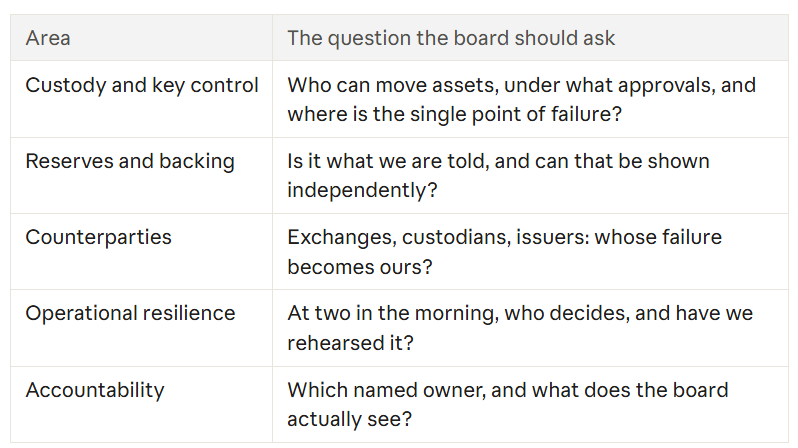
She also identified where governance typically falls short. Few directors can challenge custody, stablecoin, or smart contract risk. Boards see incident counts rather than the indicators that predict loss. The team that builds a system is often the same one telling the board it is safe. And the first 48 hours of a crisis have rarely been practised at board level.
The regulatory backdrop is tightening too. Under DORA, the management body defines, approves and oversees ICT risk. Under MiCA, only authorised providers can operate in the EU since 1 July 2026. The Basel crypto-asset standard has applied since 1 January 2026, and NIST's Cybersecurity Framework 2.0 adds a dedicated Govern function.
Susanne’s practical recommendations for boards:
- Add crypto competence to the board skills matrix, by appointing, training, or taking advice.
- Request a one-page safety dashboard, reviewed every quarter.
- Approve and minute the key numbers: hot wallet limits, approval thresholds, and loss capacity.
- Ensure independent assurance reports to the audit or risk committee, not through management.
- Rehearse. Run a board tabletop exercise on the first 48 hours, ideally with actors playing angry customers and journalists asking difficult questions.
Her closing message was simple: if you do only one thing, rehearse.
The same logic applies to custody. Institutional adoption cannot happen without knowing who actually controls the private keys, how many people must approve a transaction and whether there is a clear key-management policy. Multi-signature arrangements, secure hardware, and separation of duties all help reduce operational risk.
Vienna: building bridges
If the industry is learning to navigate uncertainty through stronger cooperation and clearer responsibilities, Vienna offered an interesting example of what that cooperation can look like in practice. If there was one recurring phrase at Bluechip26, it was ‘building bridges’: between traditional banks and crypto-native companies, and between East and West.
I was impressed to see local authorities attend, including Barbara Eibinger-Miedl, State Secretary at Austria's Ministry of Finance. Their aim is to build on the strong crypto foundation created by companies such as Bitpanda, which Peter credited with helping EU policymakers understand the market in MiCA's early days, and to make Vienna a leading crypto and financial hub for the CEE region.
'Austria is regarded as an attractive location for financial technology in Europe. With an internationally successful banking sector, innovative young companies and highly qualified professionals, we have a strong foundation on which to further strengthen our position. In this environment, events such as the Bluechip Conference provide an important platform for exchanging new ideas and fostering cooperation. What matters is enabling innovation while ensuring security and trust', said Barbara.
Ben shares that ambition. His goal is for Vienna to become a city people fly into for a crypto conference, as they already do for Germany, France, or England, especially now that so many companies have moved their EU headquarters to Austria.
Vienna has long been a meeting point for people, languages, and ideas from across Central Europe. That openness to different perspectives may be one of its greatest assets as it competes to attract digital asset businesses.
Looking back on the two days, I return to Pema. The digital asset industry has never had solid ground beneath it. Hacks, bubbles, and regulatory U-turns are part of its history. What has changed is how the industry responds: with more governance, more cooperation with banks and regulators, and more willingness to rehearse for the moment things fall apart. For bankers, PSPs, and merchants considering their next step, that may be the most reassuring signal of all.
Congratulations to the Bluechip organisers on a warm, welcoming, and thoughtfully run event. With excellent food and plenty of space for conversations between sessions, it offered the perfect setting for the kind of open exchange this industry needs. Thank you for inviting The Paypers, and we look forward to seeing you next year.
Save the date: Bluechip27 – The Crypto Safety Conference will take place on 3–4 November 2027, once again at Raiffeisen Bank International in Vienna.
About author

Mirela Ciobanu is Lead Editor at The Paypers, bridging the knowledge gap between TradFi and DeFi. With a keen eye for industry trends, she is constantly on the lookout for the latest developments in crypto and blockchain. Closely connected with subject-matter experts in the digital assets space, Mirela amplifies your voice through compelling interviews, webinars, reports, and articles.
To share more ideas and get inspired, connect with Mirela on LinkedIn or reach out via email at mirelac@thepaypers.com.
Interviews on Crypto, Web3 and CBDC
News on Crypto, Web3 and CBDC

The Paypers is a global hub for market insights, real-time news, expert interviews, and in-depth analyses and resources across payments, fintech, and the digital economy. We deliver reports, webinars, and commentary on key topics, including regulation, real-time payments, cross-border payments and ecommerce, digital identity, payment innovation and infrastructure, Open Banking, Embedded Finance, crypto, fraud and financial crime prevention, and more – all developed in collaboration with industry experts and leaders.
Current themes


No part of this site can be reproduced without explicit permission of The Paypers (v2.7).
Privacy Policy / Cookie Statement
Copyright