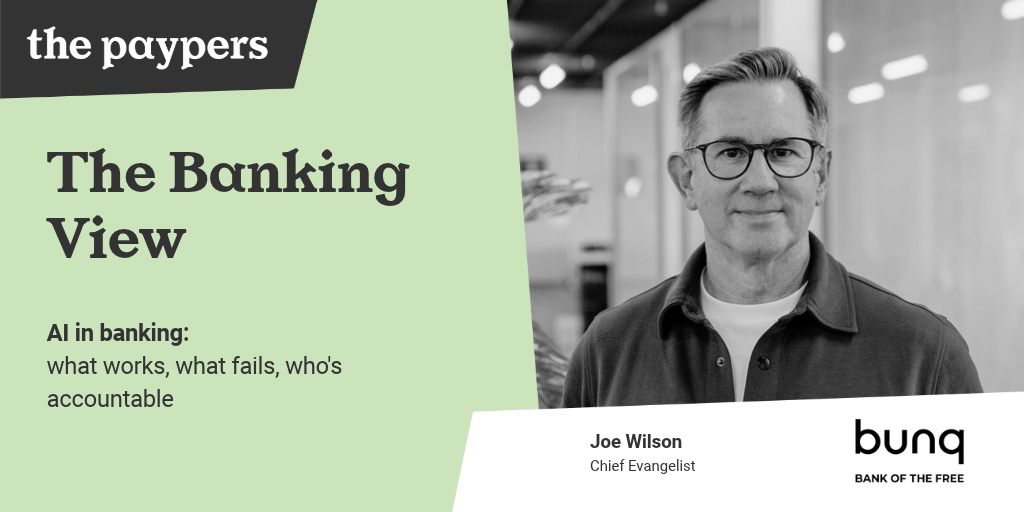
The Banking View | AI in banking: what works, what fails, who's accountable

Oana Ifrim
27 Nov 2026 / 22 Min Read
Joe Wilson, Chief Evangelist at bunq, discusses how AI is reshaping banking, from fraud prevention and instant payments to accountability for automated decisions, and why the industry's biggest gap is a lack of cooperation.
bunq was built as a neobank rather than adapting older banking systems. Does that make a real difference in how AI can be used? Where is AI already changing banking in practice, and what are the limits of what it can do reliably?
It makes a major difference. At many established banks, customer data sits in separate systems built decades apart. A model sees only a fragment of the picture, and every new use case needs integration work before it can start. That is a big reason why so much AI in banking stays stuck in pilots.
At bunq, we built our core systems ourselves (the ledger, compliance, and monitoring) and have used AI since 2016. Data is unified, so AI can see the full context of a user’s activity in real time. Because we own the whole stack, we can ship changes quickly and extend what works in one area to others without a migration project.
Finn, our GenAI assistant, is one practical example. It handles 97% of support tickets with a 90% satisfaction rate, in 38 languages, around the clock. We also use machine learning for AML checks, transaction monitoring, and fraud detection.
Being digital-first doesn’t remove every challenge, of course. Regulators expect banks to explain automated decisions and protect data, whatever their architecture. Data quality also needs constant work, and edge cases still need human judgement. That is why any user who wants to speak to a person can. The goal is for AI to handle what it handles well and to hand off cleanly when it does not.
AI is making scams harder to spot, from convincing impersonation attempts to fake identities. How is this changing the way banks detect and prevent fraud? What should financial institutions be doing differently, and what can customers realistically do to protect themselves?
Fraudsters have always impersonated banks and faked identities. AI makes it cheaper and more convincing at scale; the barrier to a credible scam has dropped significantly. The answer is to build defences faster than the attack evolves.
But that takes insight into both sides of fraud: the perpetrator and their target. Many scams are authorised by the user, so the payment itself looks legitimate. Deepfakes improve as fast as detection does. Every extra check adds friction, and too much of it pushes users away. And fraud networks operate across many banks at once, while each bank sees only its own slice.
The industry’s response needs to work on three fronts, and our own experience at bunq illustrates each.
First, detect behaviour: we combine custom rules with our own AI and ML models that monitor in-app behaviour and device signals in real time, use AI to train our deepfake detection, and require a mandatory face match before login on any unrecognised device.
Second, design around how scams actually work: victims usually only notice when the money has already left, so a short, targeted delay on high-risk payments can give users time to spot the scam and give the bank time to step in.
Third, share intelligence beyond the bank: fraudsters work across banks, fintechs, and telecoms simultaneously, so defenders must too. No single bank’s perimeter is enough on its own. Together with the Sardine risk platform, our fraud prevention systems mean bunq sees 82% fewer fraudulent incoming funds than industry peers, and users are 95% less likely to fall victim to fraud than the industry benchmark. The first measures fraudulent funds arriving on the platform across all types of financial crime, AML included, and it was published in the 2025 Annual Report.
A bank will never ask you to move money to a safe account, share a code, or approve a login you didn’t start. We take that one step further: bunq never calls you. We say so throughout the app, and a call from anyone claiming to be bunq triggers an in-app warning. If anything creates urgency, we advise users to stop and verify through the app, not through contact details the sender gives you.
Instant payments are becoming the norm, but once money is sent to a fraudster, recovering it can be difficult. When should a bank step in and slow down a payment, even if the customer wants it to go through?
A user’s money is their own, and a bank that second-guesses every payment would be frustrating to the user. However, instant payments are irreversible, and scammers exploit exactly that. Victims usually only realise something is wrong after the money has left, and by then recovery is difficult and often impossible. Responsibility, therefore, cannot end the moment a user confirms a payment.
At bunq, we think a bank should step in only when the risk is real and the cost of waiting is small. That comes down to a few principles.
Intervene on risk: slowing down every payment is a restriction, slowing down the rare payment that looks wrong is protection. The trigger should be specific signals: an unfamiliar payee, behaviour that doesn’t fit the user’s established pattern, or a combination of factors that models flag as elevated risk.
Delay, don’t deny: the bank should not decide for the user. A pause keeps the final decision with them and only adds time to think. For someone being pressured into a transfer, that time can be the moment the pressure breaks.
Make the friction proportionate: a pause should cost a legitimate payment very little, while giving a scam victim a real chance to stop. If the cost to legitimate users grows, the system is calibrated wrong. And explain why: a user who understands why a payment was held is more likely to reconsider than one who feels blocked.
Safety Shield is how we at bunq apply this. It analyses behaviour in real time and automatically delays high-risk payments by 24 hours, across all payments, stocks, and crypto. It applies only in specific cases, not to every payment. For a legitimate payment, a 24-hour pause is a minor inconvenience. For someone being pushed into a fraudulent transfer, it can be the difference between losing their money and keeping it.
There is no perfect balance. Some legitimate payments will be delayed, and some fraud will still get through, so the calibration has to be reviewed continuously as scams evolve.
Moving abroad, starting a business, or managing money with a partner can expose how complicated banking still is. What do these situations reveal about the way financial services are designed today?
They make it obvious that banking was designed around the institution: around branches, product silos, and a user profile that is less and less representative of how people actually live. A permanent employee, in one country, with a stable salary, who visits a branch.
Each of these situations breaks a different part of that model.
International mobility: someone who moves abroad often can’t open an account without a local address, a local ID, or a credit history that doesn’t carry over. They arrive needing a bank most urgently, and are least able to prove who they are in the system’s terms.
Flexible employment: freelancers, founders, and people with several income streams don’t fit a single salary and a single employer. Personal and business finances are tangled together, but banks often treat them as separate worlds with separate processes.
Shared finances: couples, families, and housemates pool money in ways the product catalogue barely anticipates. Joint accounts are often clunky, and managing shared and individual spending in one place usually takes workarounds.
The common thread is that people have to adapt to the bank, usually through paperwork, repeated verification, and extra products. The better question is the opposite one: what does this person actually need, and what is the fastest legitimate path to getting it? Technology makes this easier. At bunq, for example, digital identity checks, trusted data providers, and automated document decisions let most users open an account in about five minutes. The wider point is that speed and compliance don’t have to conflict when verification is designed around the person.
Banks that want to serve how people really live will need to redesign around that, which means treating mobility, flexible work, and shared money as the norm, not as edge cases.
As banks rely more on AI to flag fraud, verify identities, and make decisions about customers, what happens when the system gets it wrong? How should responsibility be shared?
When an AI system gets it wrong, the consequences are real: a frozen account, a blocked payment, a failed identity check. Because these systems act at scale, a single flaw can affect many people before anyone notices. The question is how a bank is built to catch them, fix them, and own them.
On responsibility: it should follow control. The bank is accountable to the user, and the bank holds its providers accountable. Users should always have a clear, accessible route to a human who can review and overturn an automated decision.
A user affected by an automated decision should be able to do three things: understand it, contest it, and get it reviewed by a person with the authority to overturn it. That requires a clear route to a human and an explanation in plain language. That is the minimum standard for any AI operating on someone’s financial life.
There are also decisions AI should not make alone. Closing an account, resolving complex disputes, and cases involving vulnerable users or unusual edge cases all need human review. AI can flag and prioritise at a speed no team could match, but the call should always be reviewable by a person.
AI, instant payments, and new forms of financial crime are evolving quickly, while regulation and banking infrastructure often change more slowly. Where is the biggest gap?
The biggest gap is between how criminals operate and how the industry defends. Criminals work as global, coordinated networks. They move quickly, test many institutions at once, and use whichever weak point they find. Defenders, by contrast, are fragmented. Each bank, fintech, and payment company largely decides alone whether a request or a payment is legitimate, using only what it can see. Adding more checks inside each institution buys time, but it doesn’t close that gap. However, there are obstacles that are practical and regulatory:
Data protection. Sharing information about customers has to respect privacy law, and the rules on what can be shared, with whom, and on what legal basis are not the same everywhere.
Legal certainty. Institutions worry about liability if shared information is wrong, and rules against tipping off a suspect can limit what can be said and when.
Fragmented standards. Different countries, regulators, and institutions use different formats, definitions, and thresholds, so even willing partners struggle to connect their systems.
Incentives and trust. Sharing intelligence helps the whole system but costs individual institutions effort and exposure, and smaller players may struggle to take part on equal terms.
Fairness. A shared signal that is wrong can lock an innocent person out of financial services across several institutions at once, so any network needs strong accuracy checks and a clear route for people to challenge errors.
None of these is a reason not to cooperate, but they explain why progress has been slow. Regulation can help most by providing clear legal bases for sharing, common standards, and safeguards for the people affected, so that cooperation becomes the easy path and not the risky one.
Fraud and financial crime will keep evolving, and no institution can outrun it alone. The direction for the industry is towards systems that connect defenders as effectively as criminals already connect themselves, with the protections in place to keep that fair for the people involved.
This contribution is part of The Banking View, The Paypers' series in which leaders and experts from banks and the banking industry around the world share their perspective on the latest developments in payments, fraud, financial crime, and regulation, as well as the evolving needs of their customers and the challenges their institutions are working through. Read all Banking View interviews.
Related in The Banking View:
AI, risk, and trust: leadership and compliance in the future of banking (https://thepaypers.com/fraud-and-fincrime/interviews/ai-risk-and-trust-leadership-and-compliance-in-the-future-of-banking);
American Bankers Association: how to win the fight against scams (https://thepaypers.com/fraud-and-fincrime/interviews/the-banking-view-american-bankers-association-how-to-win-the-fight-against-scams)
About Joe Wilson

As bunq’s Chief Evangelist and former Board Member & COO, Joe Wilson helps define the company’s voice in the world: connecting its global mission to the everyday needs of real users. With over two decades as a frontline founder and senior executive across startups, scale-ups and big tech, he tells bunq’s story with the authenticity of both an executive and a user.
About bunq

bunq, Europe’s second-largest neobank, has built the first user-centric bank. By developing a product rooted in its users’ wants and needs, bunq makes life easy for location-independent people and businesses, starting from the way they manage money: how they spend, save, budget, and invest. As the world’s first GenAI-powered bank, bunq offers its users safe, secure, and simple 24/7 financial support – user-centricity at scale.
Webinars on Fintech

The Paypers is a global hub for market insights, real-time news, expert interviews, and in-depth analyses and resources across payments, fintech, and the digital economy. We deliver reports, webinars, and commentary on key topics, including regulation, real-time payments, cross-border payments and ecommerce, digital identity, payment innovation and infrastructure, Open Banking, Embedded Finance, crypto, fraud and financial crime prevention, and more – all developed in collaboration with industry experts and leaders.
Current themes


No part of this site can be reproduced without explicit permission of The Paypers (v2.7).
Privacy Policy / Cookie Statement
Copyright