Ecommerce in 2026: four forces rewriting the rules of online retail

Diana Vorniceanu
22 Sep 2026 / 8 Min Read
Rabia Yasmeen, Global Insights Manager E-Commerce at Euromonitor International, unpacks the four forces reshaping global ecommerce growth in 2026.
As we move through the second half of 2026, where does ecommerce growth stand?
Global retail ecommerce is forecast at USD 5,250.2 billion in 2026. That is a 13% growth compared to 2025, in current prices at year-on-year exchange rates. It follows 10% in 2025 and marks a third consecutive year of acceleration from the 2022 trough of 7%. Thus, the growth performance indicates reacceleration of the channel.
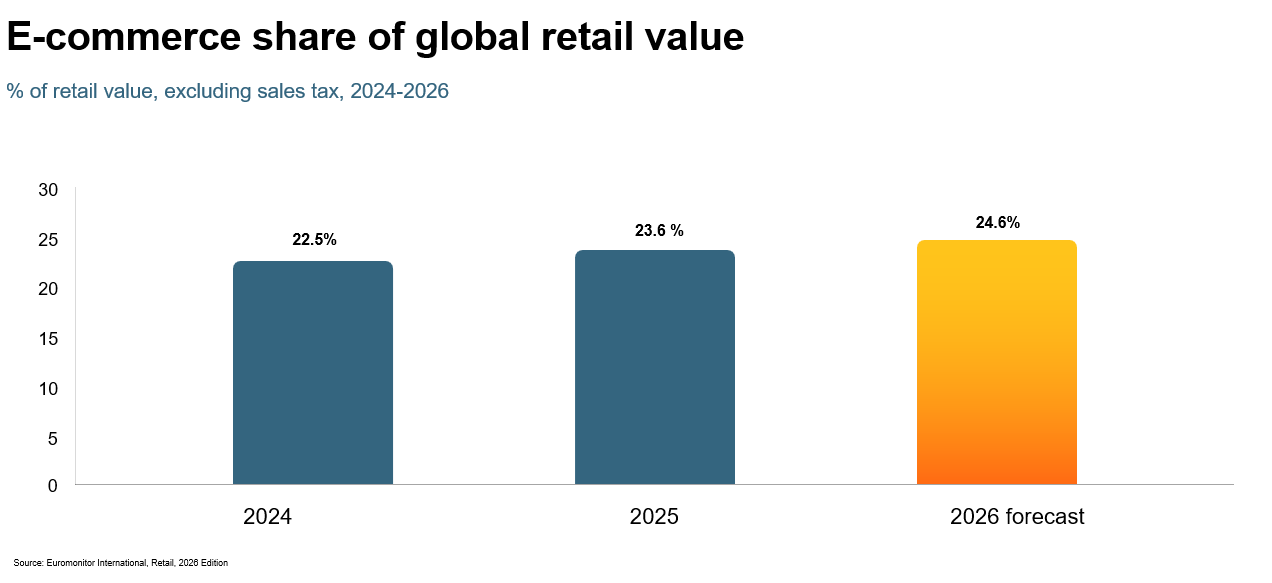
Channel share continues to grow. Ecommerce accounted for 23% of global retail value in 2024, 24% in 2025 and is forecast at 25% in 2026. Digital sales now make up nearly a quarter of global retail sales and have emerged as the principal driver of growth in the sector. With this channel accounting for 80% of the global absolute retail value increase, it underscores a strategic shift in retail, where retailers and brands are prioritising channel efficiency over expanding physical footprint.
While the growth story evolves, cross-border online retail deserves attention. In 2025, it grew by 9%, down from 14% in 2024, owing to tariff policies. This factor continues to weigh on the channel ecommerce, but the continued momentum reflects increased online penetration and growth in less mature categories such as food and grocery.
In Europe, the penetration story runs the other way around.
Europe accounts for 19% of global retail ecommerce, and USD Europe contributes around USD 45 billion of incremental online value in 2026, nearly 8% of the global increment expected this year. While Western Europe’s online retail market is more than twice the size of Eastern Europe’s, Eastern Europe is now more digitally penetrated than its western counterpart. Ecommerce will account for 23% of Eastern Europe’s retail value in 2026, against 17% in Western Europe. The difference has grown during recent years, indicating a faster pace of retail ecommerce in Eastern European markets.
Western Europe is the region most often described as saturated; however, online growth ran at 12% in 2025 and 2026 – essentially flat, with no deceleration. The market continues to expand steadily, and at 17% penetration, it sits 8 percentage points below the global average. One Western European category movement is worth watching: online food sales accelerated from 9% growth in 2025 to 14% in 2026, the region's sharpest acceleration.
Where is budget-conscious behaviour showing up most in online shopping, and how does it vary by market and demographic?
Value-seeking behaviour in 2026 is not necessarily a recessionary reflex that follows the inflation curve, but this is now a characteristic of an informed and mature shopper. Online retail in particular has been key in nurturing this behaviour.
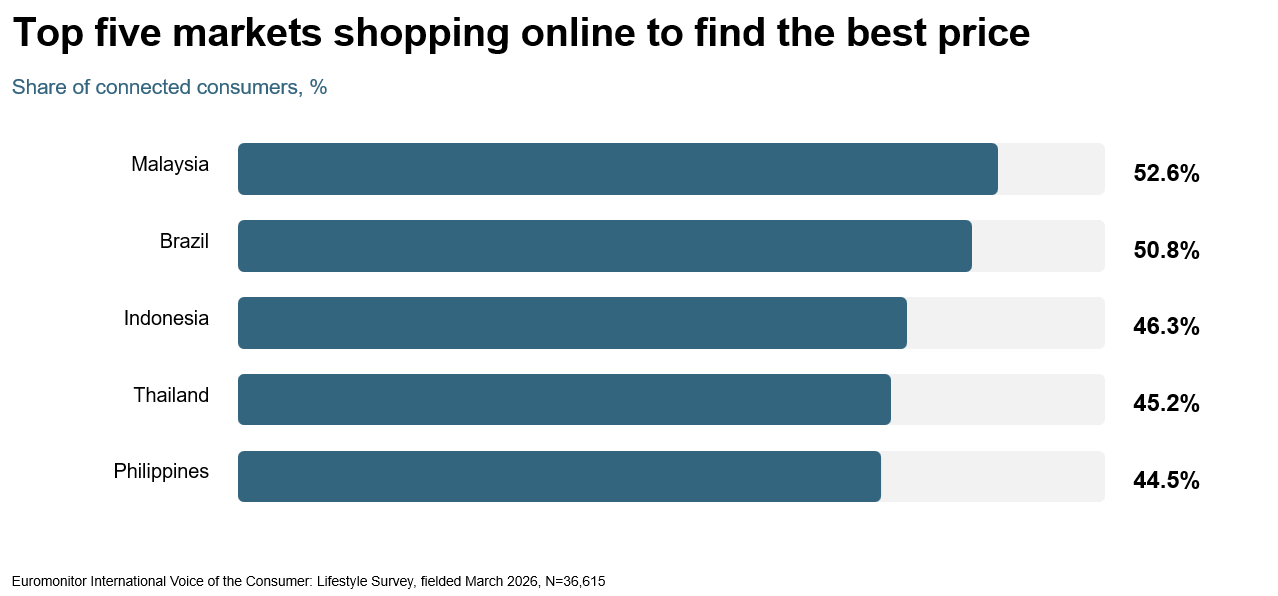
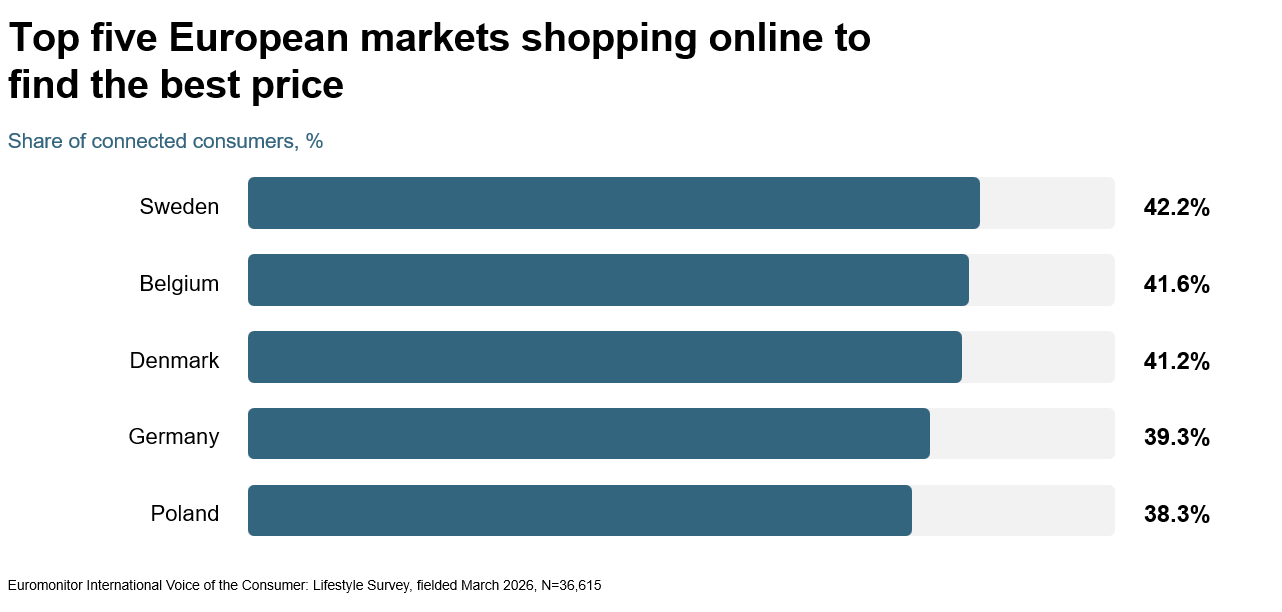
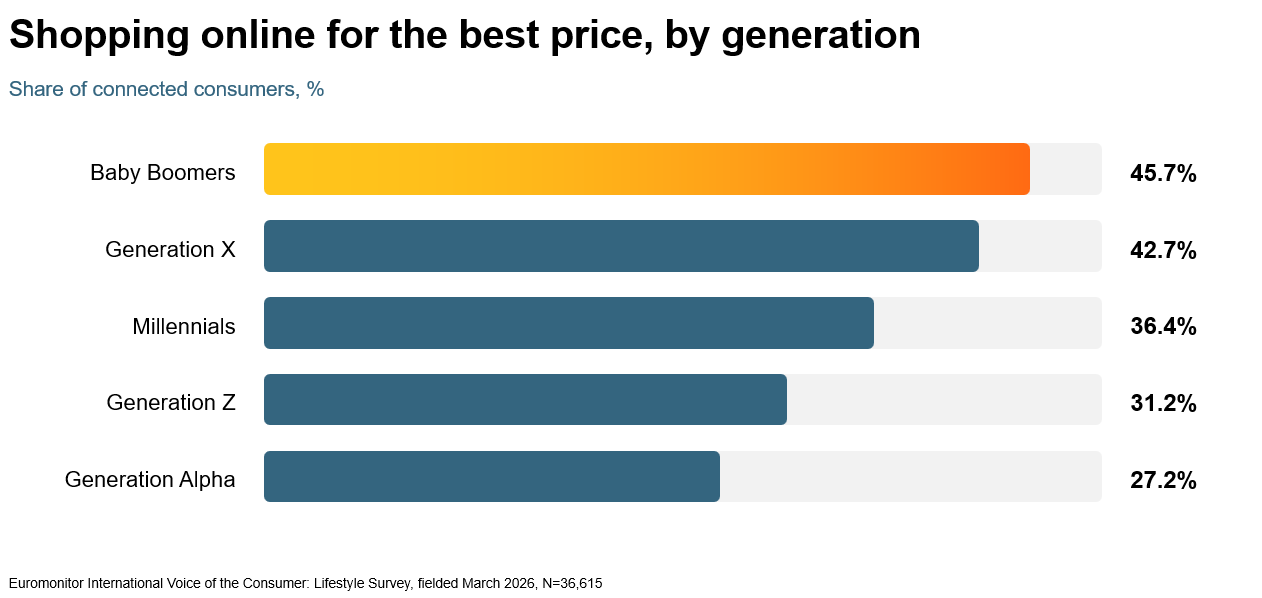
Best price continues to be the leading stated reason for shopping online in 2026, according to Euromonitor International’s Voice of the Consumer: Lifestyle Survey (N=36,566), where 37% of the global respondents state so.
- 43% of global consumers said they like to find bargains in 2026 (unchanged from 2025). Bargain-hunting has stopped being a response to conditions and has become a default setting.
- 26% of global consumers say they regularly seek private label or low-cost products in 2026 (unchanged from 2025).
- Saving money via discounts and promotions is the leading reason to participate in shopping day events. 56% of global consumers report this in 2026, followed by offers and free shipping as the second reason.
- 50% of global respondents say discounts and offers are the number 1 reason to participate in a loyalty or rewards programme.
What do you see as the forces defining online retail this year, which of them carry into 2027, and what does all of that tell a merchant deciding where to focus next?
Four forces matter in 2026; three of them carry into 2027:
- Discovery is shifting from open search to mediated choice;
- Reset in cross-border economics;
- Continued concentration around large marketplaces and quick commerce developments;
- Nominal growth flattered the year.
The biggest shift in online retail this year has been the increased penetration of AI-driven discovery. AI platforms still form a small share (around 2% of overall referral traffic to ecommerce sites), but the pace of this shift and the wider impact on how it reshapes discovery is of a larger magnitude.
According to Euromonitor International, Globally, AI-driven referrals grew by 302% in 2025, compared with 40% across all other referral sources combined. In the first half of 2026, the gap is closing - AI-driven referrals grew by 128% versus a 0.8% gain for other sources.
Generative AI is transforming product discovery from a process of navigating search results to receiving curated recommendations. Rather than comparing dozens of products themselves, consumers increasingly describe a need and rely on AI systems such as ChatGPT, Google Gemini, and retailer AI assistants, which interpret intent, compare alternatives, and recommend the most suitable brands.
However, AI does not influence every purchase equally. Its impact is greatest in high-consideration categories where consumers seek comparison, explanation, and reassurance. As AI concentrates recommendations among a small number of brands, visibility becomes increasingly scarce and therefore more valuable, creating a new competitive landscape.
While visibility in AI recommendations is becoming a key business objective for brands and merchants, this will reshape brand and product content at a large scale.
An additional discussion around this shift is the role of retailers and marketplaces. Until 2026, marketplaces have been notably the biggest destination for referrals originating from GenAI platforms. These platforms are not only the biggest source of product information that LLMs gather while making recommendations, but GenAI platforms also send the highest intent to these platforms.
The most important question for merchants is whether their products are visible, understandable and recommendable at the point where consumers are making decisions. That dynamic is likely to intensify into 2027 as commerce protocols develop and more platforms compete to sit between consumer intent and fulfilment.
The second force is the reset in cross-border economics. Regulation is making low-value cross-border commerce more expensive and more operationally complex, particularly in Europe. Governments are placing greater scrutiny on the economics, product compliance, and tax treatment of high-volume cross-border flows. Continued uncertainty around tariffs is another force – leading businesses to reconsider strategies on this front.
For merchants, this does not necessarily mean retreating from cross-border ecommerce. Most are evolving their operating model and responding by moving inventory closer to demand, increasing local warehousing and reducing dependence on direct low-value parcel flows. Thus, localisation of fulfilment is expected to remain a key theme into 2027.
Continued concentration of demand around large marketplaces is the third key aspect. Scale still matters: as pricing and value-conscious shopping behaviours continue, bigger marketplaces and platforms are best positioned to consolidate their advantage through a larger consumer base. Of the top five global retailers, four are ecommerce platforms and marketplaces. The top five global ecommerce platforms held 47% of retail ecommerce value in 2025. Amazon overtook Walmart as the world's largest retail company.
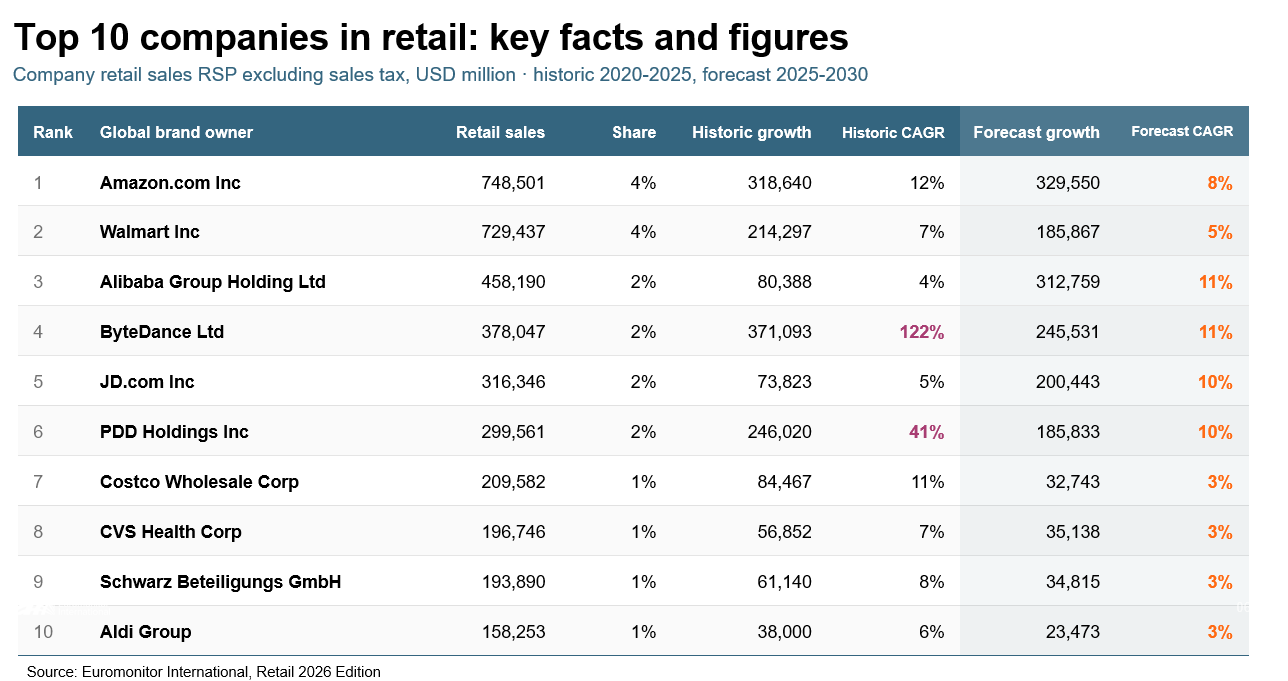
TikTok Shop demonstrates that new models can still emerge quickly, but even here the broader pattern is not fragmentation; it is the creation of another scaled ecosystem.
Another key force reshaping ecommerce is the evolution of quick commerce on marketplaces. With the introduction of 15-minute grocery services, competition around the speed of delivery is becoming a defining parameter for marketplace success, and thus becoming a core infrastructure capability layer. How far ecommerce platforms are able to balance operational efficiency and margins on this remains to be seen in 2027, but technology supporting these strategies will become an enabler and an area of investment.
AI may reinforce that concentration rather than immediately weaken it. If consumers increasingly begin their journeys through AI interfaces, those systems are likely to favour retailers and marketplaces that can provide broad assortment, reliable availability, rich product information, and efficient fulfilment.
The fourth factor is more cyclical: inflation, pricing, and currency movements. These may fade out in 2027 depending on the broader business environment, but merchants need to be disciplined in separating value growth from genuine gains in traffic, conversion, and units.
Euromonitor found AI-driven referrals grew 302% in 2025 against 40% for every other source combined. In a market like Europe, where buyers are more cautious, how much of this AI growth is real purchasing versus a click that gets handed straight back to Zalando, Bol or Amazon at checkout?
Europe accounted for 38% of the AI-driven referrals to ecommerce sites globally in 2025. In H1 2026, these referrals grew by 176% over the same period last year. UK has the highest share of AI referrals in Europe’s ecommerce landscape, followed by Germany and Spain.
While Europe is traditionally considered cautious, it’s interesting to note that the UK and Germany are among the top 5 markets globally when ranked on AI-driven referrals. UK ranks 2nd and Germany 5th according to the data for H1 2026.
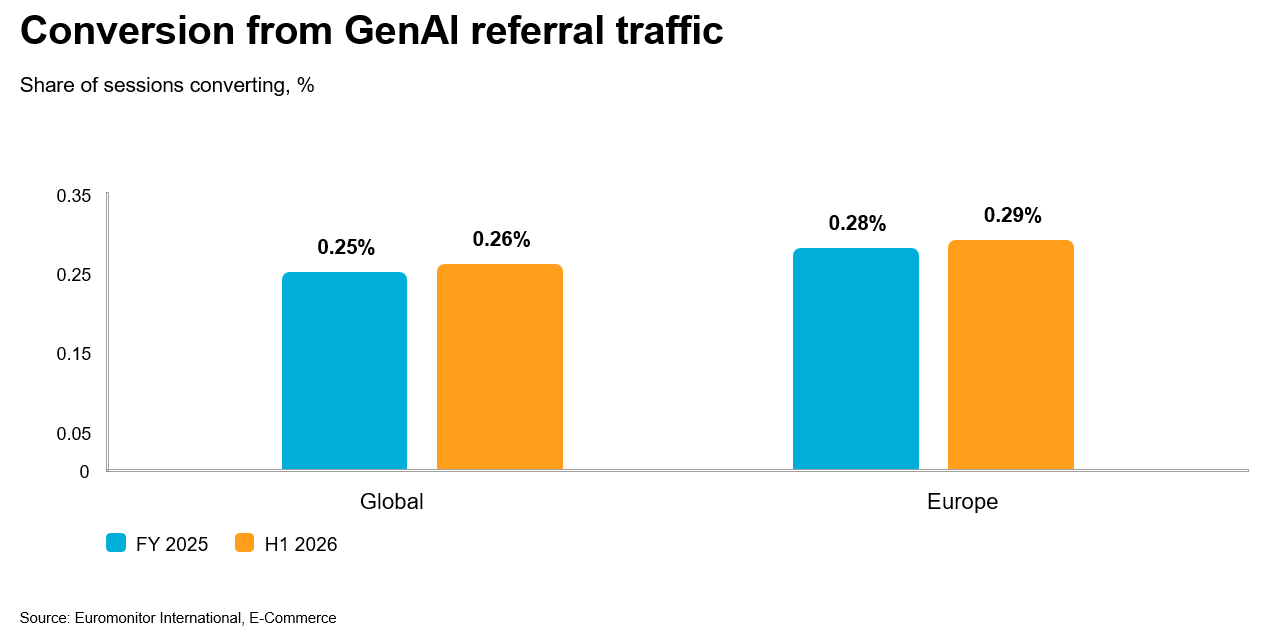
Of these referrals, 0.28% get checked out after landing on Zalando, Bol or Amazon. In 2026, the trend seems to further strengthen, as this ratio is 0.29% in H1 2026. Globally, the share of converted traffic is 0.26%. This higher conversion shows high intent of European shoppers using GenAI platforms to evaluate and make shopping decisions, leading to greater engagement.
You're chairing a panel at eCommerce Expo 2026 on how brands scale onto emerging global marketplaces beyond Amazon. What are you most looking forward to discussing there?
Amazon is the world’s largest ecommerce retailer and marketplace, but it is not the leading platform in every market. That matters because marketplace expansion is becoming much more local: consumer preferences, platform strength, fulfilment models, and routes to discovery vary significantly by country.
Amazon remains enormously important, but the marketplace landscape is increasingly fragmented. In many markets, regional, category-led and social-commerce platforms have built very strong consumer relationships of their own.
What I am most looking forward to exploring with the panel is therefore three things: how brands decide which marketplaces are strategically relevant, what it actually takes to scale profitably once you factor in localisation, fulfilment, retail media and operational complexity, and how that playbook changes as product discovery increasingly happens outside the marketplace itself.
I am particularly interested in the practical lessons and case studies: what brands found unexpected growth, and what they would do differently if they were entering a new marketplace or market today.
Rabia will be speaking at eCommerce Expo 2026, the UK's leading digital commerce event, returning to Excel London on 23-24 September 2026. Discover 200+ hours of expert content, 200+ solution providers and practical strategies covering AI, customer experience, digital growth, and retail innovation. Your free ticket also gives you access to Technology for Marketing and Parcel+Post Expo, making it the industry's most comprehensive event. Register now and build smarter commerce in the age of intelligent growth.
About Rabia Yasmeen

Rabia is a digital commerce expert at Euromonitor International with deep expertise in strategy, research, and insights. She oversees Euromonitor’s global ecommerce research. Clients across a spectrum of industries leverage her insights to understand the ecommerce landscape, trends, and opportunities to inform their strategies. Rabia’s interest in digital technologies, the platform economy, and innovation enables her to offer cross-vertical strategic insights that can accelerate value for her clients. Rabia has been featured in leading publications such as The Telegraph, Bloomberg, CNN, Retail Dive, CIM, Reuters, The National, Gulf News, and has appeared on Dubai Eye and Dubai One TV Network.
About Euromonitor

Euromonitor International leads the world in data analytics and research into markets, industries, economies, and consumers. We provide truly global insight and data on thousands of products and services to help our clients maximise opportunities, and we are the first destination for organisations seeking growth. With our guidance, our clients can make bold, strategic decisions with confidence. We have 16 offices around the world, with 1,000+ analysts covering 210 countries and 99.9% of the world's consumers, and we use the latest data science and market research techniques to help our clients make sense of global markets.
Interviews on Payments

The Paypers is a global hub for market insights, real-time news, expert interviews, and in-depth analyses and resources across payments, fintech, and the digital economy. We deliver reports, webinars, and commentary on key topics, including regulation, real-time payments, cross-border payments and ecommerce, digital identity, payment innovation and infrastructure, Open Banking, Embedded Finance, crypto, fraud and financial crime prevention, and more – all developed in collaboration with industry experts and leaders.
Current themes


No part of this site can be reproduced without explicit permission of The Paypers (v2.7).
Privacy Policy / Cookie Statement
Copyright