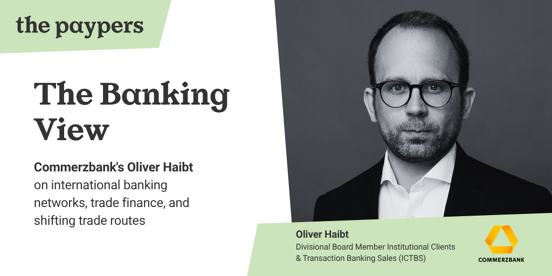
The Banking View | Commerzbank's Oliver Haibt on international banking networks, trade finance, and shifting trade routes

Oana Ifrim
08 Oct 2026 / 7 Min Read
After years of de-risking, when many banks cut ties with partners abroad, Commerzbank's Oliver Haibt explains why exporters entering new markets need banks with global connections and quick, sound risk decisions.
In this interview with The Paypers, Oliver Haibt, Divisional Board Member for Institutional Clients & Transaction Banking Sales (ICTBS) at Commerzbank, explains how international banking networks and trade finance are adapting as companies reconfigure their supply chains. Oliver, who has spent 29 years at Commerzbank, discusses the bank's role in around 30% of Germany's foreign trade, how years of de-risking have reshaped global banking networks, the digitalisation of trade documents through eUCP and AI-based compliance checks, the potential of ISO 20022 payment data, and how banks and fintechs complement each other in cross-border payments.
You’ve spent 29 years at Commerzbank, in corporate clients and most recently in the private customer business. What made this role the right next step, and what perspective does that mix of experience bring to it?
I have been fortunate to gain experience across several areas of Commerzbank, and I am excited to bring my experience to the Institutional Clients & Transaction Banking Sales business. The role is a natural next step because it brings together many of the topics that have shaped my career: customer relationships, international business, transaction banking, and the delivery of high-quality solutions. I have always worked in customer-facing roles, which is the part of banking I enjoy most. Although the customer groups differ, the fundamentals remain the same: understanding clients’ needs and helping them achieve their objectives.
My experience across corporate clients and the private and small-business customer business also gives me a broad perspective on how the different parts of the Bank connect. In this role, I can draw on that experience while working with an excellent team whose deep expertise is a real strength. Together, our ambition is to deliver modern, high-performance solutions that help corporate clients and financial institutions succeed.
ICTBS covers two quite different customer groups, other financial institutions on one side, corporate clients buying transaction banking services on the other. How do those two halves reinforce each other?
The two sides are closely connected through international trade. As companies reassess their supply chains and explore new markets, they increasingly depend on banking partners that can provide reliable access to local markets and efficient cross-border services. We are seeing renewed efforts to develop trade relationships between Europe and the Asia-Pacific region, including India and Indonesia, as well as with the Mercosur countries in South America. At the same time, German corporates are seeking to maintain strong relationships with major trading partners such as the US and China.
Financial institutions have their own specific priorities. Correspondent banking is increasingly focused on service efficiency, with clients expecting rapid execution, reliability, and responsiveness. Years of de-risking have also led many banks to reduce their international relationships in favour of regional or local models. As companies enter new markets, financial institutions need trusted partners in countries where their own capacity may be limited or no longer available. This is where ICTBS brings distinctive value: supporting financial institutions through strong correspondent banking relationships while helping corporate clients access the transaction banking expertise and international connectivity they need.
Correspondent banking rarely gets discussed outside the industry, but very little international trade works without it. What does a worldwide network of banking relationships make possible for your clients?
A global network of banking relationships enables international payments, trade finance, and settlement to work smoothly across borders. Germany’s export-focused economy depends on this infrastructure, and Commerzbank facilitates around 30% of Germany’s foreign trade. Our strong international presence, including activity in more than 40 countries, enables us to cover major trade corridors and support clients as they expand into new markets.
For clients, this means access to local knowledge as well as global reach. Our teams understand local customs, conventions, and regulatory environments, while our expertise covers the full range of international trade requirements – from documentary collections, letters of credit and guarantees to trade finance and the digital administration of documentary payments. For more than 150 years, supporting businesses in their international activities has been part of Commerzbank’s DNA. This long-standing experience gives clients the expertise and confidence to navigate the specific requirements and risks of cross-border transactions.
Take a German mid-sized exporter entering a market where the local banking system is still developing. What does good support look like at ground level?
Banks play two fundamental roles in supporting global trade. First, they facilitate the transaction itself through instruments such as documentary collections, letters of credit and guarantees. Secondly, they help manage the associated risks, including documentary, performance, payment, and financial risks. The banks best placed to provide this support combine global connectivity with a strong reputation for integrity, efficiency, and sound risk management.
However, simply having a presence in a market is not enough. Good support means aligning the Bank’s wider infrastructure behind that presence: adapting products to local requirements, ensuring that operations can manage time-zone differences, aligning risk appetite with local counterparties, and making sure teams understand the regulatory and cultural context. Clients need more than credit. They gain access to global expertise that helps them identify opportunities, integrate their operations or supply chains into new markets, and manage the uncertainty that often accompanies international expansion.
Trade finance instruments like letters of credit and guarantees have been around for centuries. What’s changing about how they’re used as supply chains are reconfigured?
The instruments themselves remain highly relevant, but the context in which they are used is changing. Energy prices, the availability of foreign currency, and countries’ balance-of-payments positions can all influence trade flows and the appetite for confirming letters of credit. Some energy-importing markets may face pressure on their external finances, while energy-producing countries may benefit from higher revenues. This can affect import priorities, energy consumption and the routes through which goods move. Higher fertiliser prices may also affect food prices and availability, just as we saw during the Covid period and following the outbreak of the war in Ukraine.
The key requirement is adaptability. Manufacturers are seeking new suppliers and markets at short notice, and trade finance structures must be capable of adjusting accordingly. Digital exchanges and processes are generally easier to adapt than paper-based flows, allowing banks to realign support more quickly. The ultimate impact on trade will depend not only on the level of energy prices, but also on how long current conditions persist and how businesses and governments respond.
Trade documentation has been moving from paper to digital for years now. Where is that progress making a real difference for exporters?
Digitalising trade finance is more than a technical upgrade. Integrated digital platforms can replace slow, paper-heavy processes with real-time data sharing between banks, corporates, and logistics providers in different locations. This delivers greater efficiency and transparency, reduces errors and costs, and gives exporters significantly better visibility over the status of their transactions. It can also strengthen risk management by supporting earlier detection of irregularities, more efficient KYC and AML processes, and predictive risk assessment.
The technology itself is developing quickly, and as one of Europe’s leading trade finance banks, we see this as a clear sign that digital trade is moving from concept to reality. Blockchain can provide secure and tamper-resistant transaction records, artificial intelligence can support document verification and compliance checks, and the Internet of Things can connect goods in transit with their financial flows. For example, Commerzbank has already begun this journey with electronic presentations of documents linked to the adoption of the Electronic Uniform Customs and Practice for Documentary Credits (eUCP), and digital compliance checks using artificial intelligence. Nevertheless, digital capability must be combined with established trade finance expertise, global reach and market experience. That combination is essential if exporters are to enter new markets securely and confidently.
Instant payments, ISO 20022, verification of payee. A lot has arrived at once. Which of these matters most for corporate clients, and why?
ISO 20022 will provide an important foundation, even with the delayed go-live. Its richer and more structured data can support straight-through processing, automation, streamlined reconciliation, faster investigations, and greater transparency. It can also strengthen compliance and fraud prevention by reducing ambiguity in payment information. For companies with large cross-border payment volumes or complex reconciliation processes, these benefits can be particularly significant.
The greatest opportunity lies in building innovative services on that foundation. When structured data is combined with APIs and Open Banking, it can support improved analytics, more personalised services, and potentially new digital-commerce business models. However, the benefits will not be identical for every organisation. Banks need to work with ecosystem partners and understand each client’s specific requirements before deciding how best to use these capabilities. For cross-border payments in particular, different countries, currencies, and legal requirements remain important considerations, so experienced support continues to be valuable.
Cross-border payments have become a crowded field, with fintechs and payment providers alongside banks. How do you see the different players complementing each other, and where do banks contribute most?
The payments landscape benefits from a range of specialised participants. Technology-led providers can contribute agility and focused digital capabilities, while banks bring established networks, balance-sheet strength, regulated infrastructure, and experience in managing complex international relationships. These capabilities can complement one another, particularly as corporate clients seek faster, more transparent and more efficient cross-border services.
Banks’ contribution is especially important in managing bank and country risk. Over the past 25 years, sanctions, financial crime and anti-money laundering requirements have expanded considerably, while counterparty risk must also be assessed and reflected on balance sheets. This complexity has led some institutions to withdraw from markets or relationships that were considered too risky or resource-intensive. As companies reconfigure their supply chains, banks will need to evaluate new markets and correspondent relationships quickly, reach well-founded credit decisions and provide clients with clarity. That powerful combination of connectivity, trust, risk management and regulatory expertise is where established banks continue to deliver exceptional value for their clients.
This interview is part of The Banking View, The Paypers' series featuring senior bank executives on the payments and regulatory challenges their institutions are working through. Read all Banking View interviews.
About Oliver Haibt

Oliver is currently the Divisional Board Member for Institutional Clients & Transaction Banking Sales at Commerzbank AG, responsible for the global relationship management of Financial Institutions and Non-Bank Financial Institutions (as part of this, overseeing Commerzbank’s correspondent banking network and representative offices), as well as the distribution of Cash Management and Trade Finance products.
Furthermore, he holds supervisory and advisory board mandates e.g., EURO Kartensysteme GmbH (Member of the Supervisory Board), Clearstream Group (Member of the Advisory Board Committee). He also serves as Co-Chairman of the Supervisory Board and Committee of Commerz Direktservice GmbH and is a member of the Swift Council.
Oliver started his career at Dresdner Bank in Frankfurt, where he held various roles in interest rate derivatives, FX sales and structuring. He has more than 25 years of experience in the financial industry in a variety of roles across capital markets, corporate and institutional banking, retail and SME strategy, payments and strategic management.
Oliver holds a Master of Arts in Banking & Finance from the Frankfurt School of Finance & Management and spent an exchange semester at the Université du Québec, Montréal, Canada. He speaks English, French, and German fluently.
About Commerzbank

Commerzbank is the leading bank in the corporate clients business in Germany and for the German Mittelstand and a strong partner for around 24,000 corporate client groups and accounts for approximately 30% of German foreign trade. The Bank is present internationally in more than 40 countries in the corporate clients’ business – wherever its Mittelstand clients, large corporates, and institutional clients need it. In addition, Commerzbank supports its international clients with a business relationship to Germany, Austria, or Switzerland and companies operating in selected future-oriented industries.
Interviews on Payments
Expert views on Payments

The Paypers is a global hub for market insights, real-time news, expert interviews, and in-depth analyses and resources across payments, fintech, and the digital economy. We deliver reports, webinars, and commentary on key topics, including regulation, real-time payments, cross-border payments and ecommerce, digital identity, payment innovation and infrastructure, Open Banking, Embedded Finance, crypto, fraud and financial crime prevention, and more – all developed in collaboration with industry experts and leaders.
Current themes


No part of this site can be reproduced without explicit permission of The Paypers (v2.7).
Privacy Policy / Cookie Statement
Copyright