The future of finance: strengthening security with quantum-resistant networks
Estera Sava
10 Nov 2026 / 8 Min Read
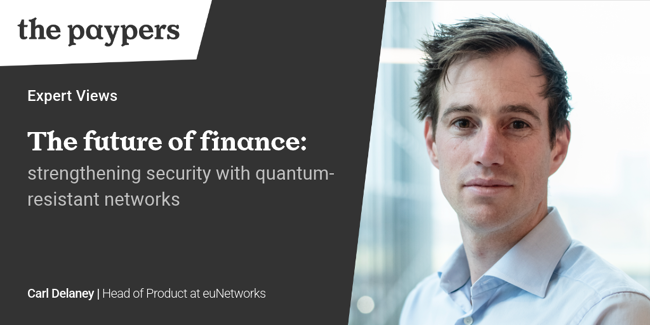
Carl Delaney, Head of Product at euNetworks, shares why quantum-resistant networks are the next step in financial security.
Cloud computing, digital payments, and real-time financial services have changed how the financial sector operates. Over the last 10 years, institutions have invested heavily in digital banking, cloud infrastructure, and more recently, AI-driven analytics to improve efficiency and customer experience. LSEG’s 2025 global survey found that 82% of financial services firms surveyed operated a hybrid or multi-cloud strategy, with digital payment volumes and cloud-based services continuing to grow each year.
However, increasingly distributed environments create more points of exposure. When cyber-attacks turn more sophisticated and targeted, financial organisations must protect sensitive information as it moves between systems, providers, and locations. In 2025, the finance and insurance sector accounted for 23% of cyber incidents investigated by IBM X-Force, making it one of the most targeted industries.
In response to these growing risks, financial institutions (FIs) across Europe are placing greater emphasis on securing data in transit. Large-scale quantum computers could eventually compromise cryptographic methods currently used to secure information, prompting greater focus on post-quantum security.
DORA for FIs, and more broadly the NIS2 Directive, are raising requirements for encryption, crypto-agility, and sensitive traffic protection across private and third-party infrastructure. Also, the EU’s coordinated post-quantum roadmap targets 2030 for high-risk systems and critical infrastructure migration to post-quantum cryptography. These developments bring critical network infrastructure security into sharper focus, especially the need to maintain visibility and control over how data moves between systems and providers.
Network security and resilience are fundamental to all organisations handling sensitive financial information. Infrastructure must support evolving security standards without compromising performance.
Understanding risk in distributed infrastructure
Financial services depend on data moving easily between multiple environments. Payment systems, fraud prevention tools, trading platforms, and customer-facing applications might rely on infrastructure spread across private data centres, cloud platforms, and external providers. Although this gives FIs greater flexibility in how they deliver services, it also creates more complexity for network teams to manage. With data crossing multiple environments, it is not straightforward to establish where it travels and whether it is secure.
From a regulatory standpoint, FIs are expected to manage ICT risks across their entire technology stack, including the network connections linking internal systems with cloud platforms and third-party providers. This creates a growing gap between the risks FIs must manage and the complexity of the infrastructure they oversee.
Securing data across the network
FIs have traditionally focused most security investment on applications, endpoints, and protecting stored data, all areas that should not be overlooked. However, the growing systems interconnectivity means sensitive information now moves across multiple environments in daily operations. This creates additional security risks that need to be addressed.
A single transaction might pass through a data centre, a cloud platform, and a third-party processor before it settles. Without sufficient visibility into how traffic moves between these environments, it is increasingly difficult to identify potential weak points and unusual activity.
Another risk is encrypted data that is intercepted today and stored for future decryption. Known as 'harvest now, decrypt later', this approach involves adversaries collecting sensitive information now, hoping to decrypt it when sufficiently powerful quantum computers become available. Financial data that must be confidential for many years is particularly exposed if it relies on cryptographic methods vulnerable to future quantum attacks.
Quantum-resistant encryption provides an essential protection layer, but regulated institutions also need to monitor traffic routing and quickly identify activity that falls outside expected patterns. Financial organisations must be confident that data moving between these environments is protected with the same security level as data at rest.
Designing networks for resilience
These developments are changing what FIs need from their networks. Reliable performance is critical, but it must be supported by an architecture that protects sensitive information and adapts to changing security requirements. Dedicated private connections between key sites help maintain control over data flows; simultaneously, quantum-resistant encryption at the optical layer protects information as it travels across the network, complementing application and other network security controls. Physical route visibility, fibre monitoring, and traffic monitoring also give OPS teams a clearer understanding of network activity and potential vulnerabilities. These capabilities address different aspects of network resilience and must work in tandem to protect sensitive financial data.
Moreover, network flexibility will become more important as cryptographic requirements evolve. Infrastructure that can accommodate new cryptographic standards without major redesigns will help FIs strengthen security, while maintaining critical applications’ performance.
Ultimately, network resilience depends on how well private connectivity, encryption, network monitoring, and adaptable cryptographic capabilities are integrated into infrastructure. Getting this right early will help FIs protect the services operations depend on, giving customers greater confidence in their systems’ security and integrity.
Preparing for the post-quantum era
Post-quantum security requires early planning and action from FIs and networks that can accommodate new cryptographic requirements without putting critical services at risk for customers.
Investing in dedicated infrastructure, stronger network visibility, and secure data transmission will help institutions manage new standards while maintaining vital service continuity. The future security of financial services depends on infrastructure that can adapt as quickly as the threats it faces.
About the author

Carl Delaney is Head of Product at euNetworks, a pan-European bandwidth infrastructure provider specialising in high-performance Fibre, Wave, and Ethernet connectivity. He leads product strategy and development across the company’s metro and long-haul networks, delivering scalable, high-capacity solutions that connect key data centres and cloud platforms across Europe. Carl works at the intersection of technology and commercial strategy, focusing on building connectivity products that support the evolving needs of finance, cloud, content, enterprise, and wholesale customers. With deep industry expertise and a passion for digital infrastructure, he is key in enabling the resilient, high-performance networks powering today’s data-driven economy.
News on Fraud and Fincrime
Expert views on Fraud and Fincrime

The Paypers is a global hub for market insights, real-time news, expert interviews, and in-depth analyses and resources across payments, fintech, and the digital economy. We deliver reports, webinars, and commentary on key topics, including regulation, real-time payments, cross-border payments and ecommerce, digital identity, payment innovation and infrastructure, Open Banking, Embedded Finance, crypto, fraud and financial crime prevention, and more – all developed in collaboration with industry experts and leaders.
Current themes


No part of this site can be reproduced without explicit permission of The Paypers (v2.7).
Privacy Policy / Cookie Statement
Copyright