The hidden cost of a fragmented payments stack
Paula Albu
16 Nov 2026 / 5 Min Read
Most payments companies run on a stack that was assembled rather than bought: a processor from one supplier, a gateway from another, 3DS, a token vault, and wallet integrations from elsewhere. Each choice made sense at the time. Together, they create costs that rarely appear as a single line item, which is why few teams have ever added them up.
In the webinar hosted by The Paypers and DECTA, The fragmentation problem: what a payments stack assembled from four or five vendors really costs, Gabriel Stefanak, Chief Business Development Officer, and Oleg Grinko, Chief Marketing Officer, both at DECTA, and Yuriy Kostenko, Partner at Flagship Advisory Partners, joined moderator Joy Macknight, Financial Journalist, to discuss where these costs arise, how to calculate them, and when consolidation makes sense.
Here are the key takeaways from the webinar.
How a payment stack becomes fragmented
Yuriy started the conversation by describing three models among European payment providers: those built on a single in-house platform, large providers shaped by years of acquisitions, and, most commonly, regional providers combining their own technology with external suppliers. For the latter, the stack typically has three layers: the gateway and acceptance layer, often built in-house; processing and acquiring, usually provided by one or more partners; and supporting capabilities such as KYC, fraud screening, and tokenization, alongside value-added services like merchant cash advance, each with its own suppliers.
Every addition makes sense on its own, he said, but as providers add acquirers, fraud tools and payment methods, they remain responsible for making everything work together. Gabriel added that the complexity often starts before launch: core banking with SEPA or SWIFT, issuing with its card management, 3DS, fraud, and tokenization components, and scheme services that small PSPs can find hard to navigate.
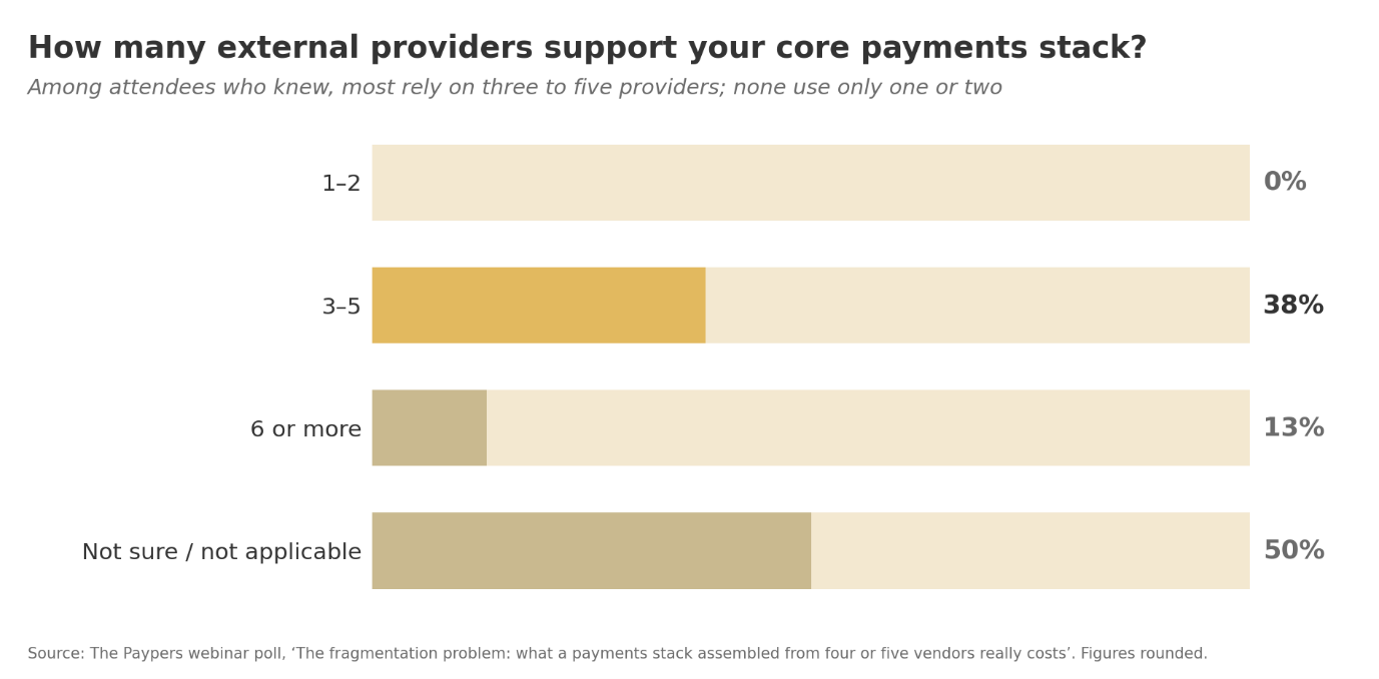
A live poll showed how common this is: 38% of attendees rely on three to five external providers for their core stack, and none on only one or two. Half were not sure, and Oleg noted that counting every vendor needed to run the business would take most companies well beyond dozens.
The costs that do not show up in an RFP
Yuriy identified three problems: duplicated effort, as scheme mandates and updates must be implemented across several platforms; fragmented accountability, where each vendor meets its own SLA but the merchant still gets a poor outcome; and limitations that become visible to merchants, from slow launches to inconsistent reporting, which can lead to churn.
Gabriel pointed to the hidden costs behind them: managing contracts, SLAs, and scheme mandates across vendors; compliance work under DORA, from collecting vendors’ PCI DSS and ISO certifications to reporting to regulators; and the change requests that come with every new market, raising the question: who pays? For Yuriy, the highest cost is opportunity cost. Engineering time spent on maintenance is not spent on new products, so the cost shows up twice: in the work and in the delayed revenue. Each new supplier also adds ongoing governance and another roadmap the provider cannot control.
Calculating the true cost
Typical RFPs compare cost per card, authorisation, or merchant, Gabriel said, but rarely the cost of scheme mandates or change requests, and minimum commitments are often calculated differently by each vendor. Total cost of ownership is the one metric that gives the right answer. Yuriy suggested estimating how much time engineering, operations, finance and risk teams spend on integrations, reconciliation and supplier coordination, then applying fully loaded staff costs. It is never perfect, but it makes visible costs that are otherwise spread across department budgets. Transition costs, from testing and certification to running two setups in parallel, also need to be counted, as they often help keep existing suppliers in place.
What triggers a review
A stack review rarely starts in the CTO’s office, said Oleg. The triggers are usually outages beyond a provider’s control, regulators asking who stands behind the business, or a CFO comparing vendor costs with revenue.
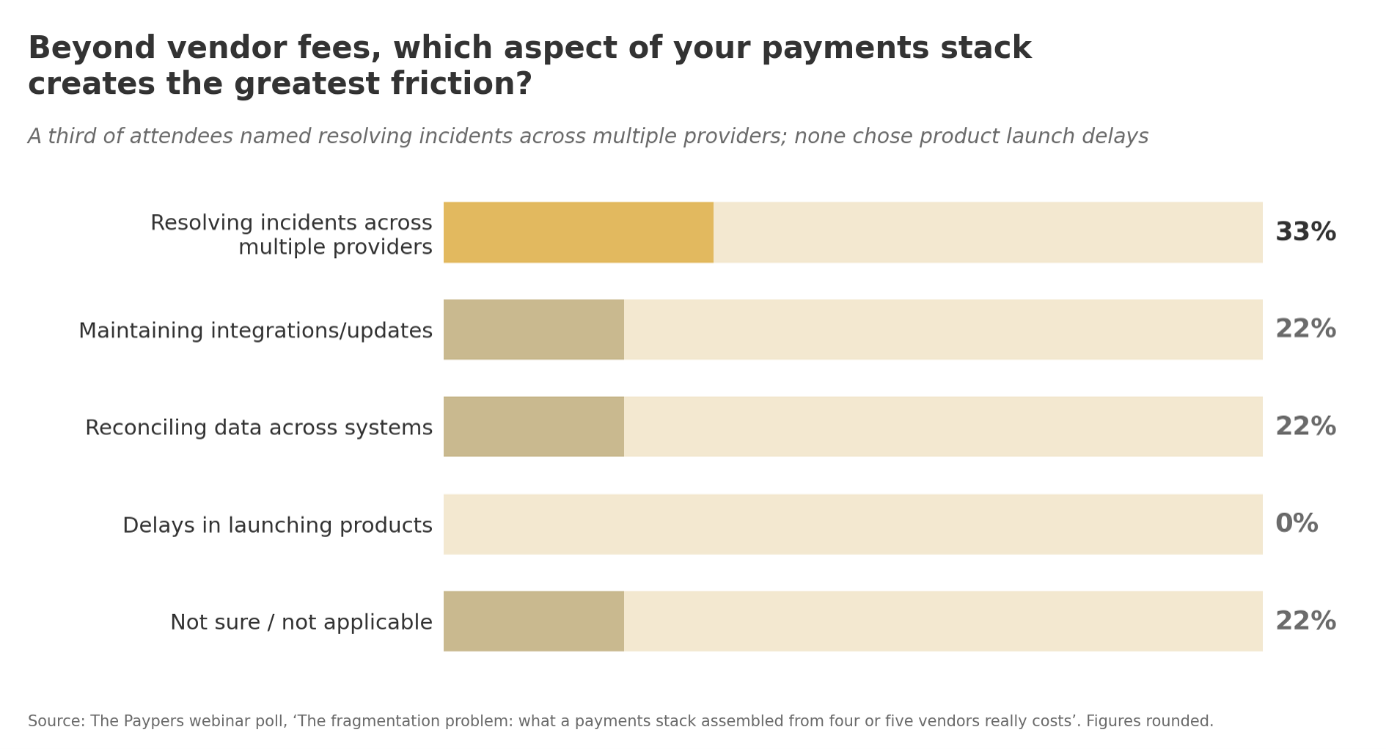
The second poll pointed to where the friction is greatest: a third of attendees named resolving incidents across multiple providers, while none chose delays in launching products.
For Yuriy, single incidents are manageable; it is their persistence, and the gap between a supplier’s capabilities and the provider’s ambitions, that usually prompts a change.
When consolidation makes sense
A stack that processes today’s transactions reliably may still make tomorrow’s growth slow and expensive, Yuriy said. Consolidation can bring efficiency, speed through building a capability once for all customers, and control through better visibility and clearer accountability. But the benefits must be proven: one supplier can still run several disconnected platforms behind a single contract. Reducing migration risk starts with defining what must be preserved, from payment methods and token portability to settlement and reporting.
Oleg suggested three questions to consider when evaluating any provider: what are the variable costs, since the price you compare isn’t always the price you pay; which vendors sit behind the vendor; and who owns end-to-end uptime.
What comes next?
The discussion closed with some practical advice from the speakers. Gabriel recommended starting with total cost of ownership and checking whether the current stack can support the next three to five years. Yuriy warned against adding platforms without retiring old ones, as every migration needs a decommissioning plan, measured by customer outcomes and costs removed.
The overall message was clear: a fragmented stack rarely fails all at once. It slows a business down, one integration, one incident, and one delayed launch at a time, and the cost only becomes visible once someone adds it up.
This webinar recap highlights the key points of the discussion. For the full conversation, including the Q&A session at the end, watch the webinar recording here.
About DECTA

DECTA is a European payments infrastructure company. For more than ten years, we’ve helped merchants, fintechs, EMIs and banks accept, process and issue payments; today, over 2.000 businesses work with us. From payment acceptance and processing to card issuing and digital banking, our team builds and runs the infrastructure our clients rely on. Find out more at decta.com.
News on Payments
Expert views on Payments

The Paypers is a global hub for market insights, real-time news, expert interviews, and in-depth analyses and resources across payments, fintech, and the digital economy. We deliver reports, webinars, and commentary on key topics, including regulation, real-time payments, cross-border payments and ecommerce, digital identity, payment innovation and infrastructure, Open Banking, Embedded Finance, crypto, fraud and financial crime prevention, and more – all developed in collaboration with industry experts and leaders.
Current themes


No part of this site can be reproduced without explicit permission of The Paypers (v2.7).
Privacy Policy / Cookie Statement
Copyright