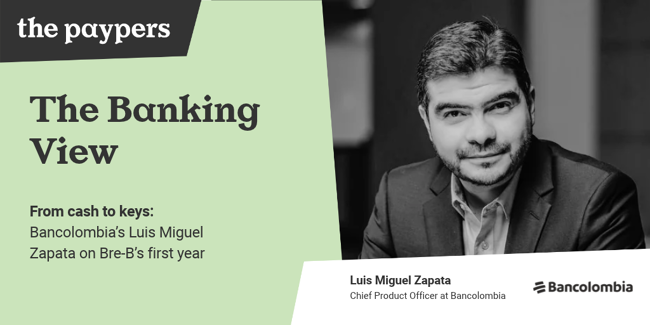
The Banking View | From cash to keys: Bancolombia’s Luis Miguel Zapata on Bre-B’s first year

Oana Ifrim
25 Nov 2026 / 10 Min Read
In its first year, Bre-B brought 36 million users to instant payments. Bancolombia’s Luis Miguel Zapata on what drove adoption, how the bank protects customers from fraud, what comes next for merchants and businesses, and what European banks can learn.
You trained as an engineer, studied economics, and completed an MBA at Babson College, then built your career at Bancolombia through roles in corporate strategy and strategic alliances before leading digital ecosystems. How has that path shaped the way you think about partnerships and building services with others, and what lessons from those earlier roles do you draw on most today?
My career has taught me that the most valuable solutions rarely come from a single perspective. Engineering gave me a systems mindset; economics, an understanding of incentives and value creation; and business, the discipline of execution: how to turn an idea into something that works at scale.
Yet the most important lesson came from working across strategy, partnerships, and ecosystems: the future is not built alone.
Financial services today are increasingly about connecting capabilities. Banks contribute trust, infrastructure, risk management, and scale. Fintechs and technology companies bring speed, specialised capabilities, and new experiences. Businesses offer deep knowledge of their customers and industries. When these strengths are aligned around a real customer need, the value created far exceeds what any single participant could achieve alone.
That is why I am a firm believer in ‘coopetition’: cooperating and competing at the same time to create value. The question is no longer ‘What can the bank build?’ but ‘What can we enable together?’
As Vice President of Digital Ecosystems at Bancolombia between May 2019 and March 2026, you led the evolution of the bank’s offer towards ecosystem and Banking-as-a-Service models. How does Bre-B fit into that strategy, and what does an instant, interoperable payment system make possible for the partners and services built around Bancolombia?
Bre-B is a natural part of a broader transformation already under way: banking is becoming more open, connected, and embedded in the experiences people and businesses use every day.
At Bancolombia, we have been building capabilities such as Banking-as-a-Service so that fintechs, technology companies, and large corporations can integrate financial services into their own platforms. Instant, interoperable payments strengthen that model by removing friction from one of the most important layers of any ecosystem: moving money.
That is why Bre-B matters far beyond the payment itself. It creates common rails that make it easier for banks, wallets, fintechs, and businesses to connect. Customers can move money simply and instantly across institutions, while partners can design new services on top of that infrastructure.
For me, that is the larger opportunity: turning infrastructure into a platform where multiple participants can create value.
Colombia’s payments landscape has changed quickly, from a largely cash-based economy to digital wallets and now Bre-B, the central bank’s instant payment system. How would you describe the evolution of the country’s payments ecosystem, and how have instant, interoperable payments changed the roles of banks, wallets, fintechs, and merchants?
I would describe Colombia’s evolution as a journey from access to digitisation, and now to interoperability.
For years, the strong preference for cash has been one of our biggest challenges, even as financial access and digital usage have grown significantly. Before Bre-B, Colombia had already built important foundations through Transfiya, PSE, and interoperable QR payments. Those experiences proved something essential: Colombians adopt digital payments when they are simple, useful, and trusted.
Bre-B goes one step further, creating a shared language for instant payments across the financial system.
That changes the role of every participant. Banks no longer compete solely through closed infrastructure. Wallets and fintechs can take part in a far more connected environment. Merchants gain more ways to get paid, and customers gain more freedom to choose how and where they pay.
Interoperability, in short, moves competition to a higher plane: the quality of the user experience and the value we create for customers.
Bre-B passed 36 million users and 116 million keys in its first year. What surprised you most about how Colombians took to it, and how has the year looked from Bancolombia’s side?
What stands out most is how quickly people will change a deeply rooted behaviour when the alternative is genuinely simpler.
A key is a very simple concept: instead of thinking in terms of account numbers and institutions, you identify where you want your money to go by using something familiar, such as your phone number, ID, or email. That removes a great deal of friction from the customer experience.
Still, this adoption did not happen overnight. Colombia had been creating the conditions for it for years. Strong uptake of digital channels, immediate transfers, and QR payments meant customers were already comfortable moving money digitally.
From Bancolombia’s perspective, this first year of Bre-B has reinforced an important lesson: launching the infrastructure is only part of the job. Adoption depends on education, trust, security, and very simple experiences. We anticipated that educating customers about keys would be one of Bre-B’s main challenges, and education remains essential as the ecosystem grows.
During Bre-B’s first year, the ecosystem surpassed 1.7 billion transactions worth COP 262+ trillion, reaching 36 million users and 116 million registered keys. Bancolombia and Nequi, both companies from Grupo Cibest, have 50.11% of all registered keys, positioning the group as a leading player in the shift toward less cash, greater interoperability, and simpler payment experiences.
Bancolombia migrated its existing keys and linked its customers’ QR codes to Bre-B. What did it take to move millions of customers onto a new national system without disrupting their everyday payments?
The principle was simple, even if the execution was complex: the technology had to change without adding friction to the customer experience.
A migration of this scale demands far more than technical integration. Technology, operations, customer experience, and communications have to work as one system, and the new infrastructure has to connect thoughtfully with existing customer behaviours.
Colombia also had an important advantage: interoperable QR payments and key-based transfers had already made these experiences familiar. Our work on Mi Bancolombia – our banking app – and Tus Llaves – our strategy to teach customers how to use and register their keys – was designed to prepare customers for the transition to Bre-B.
It illustrates a principle we apply often: transformation succeeds when technology, operations, and business move together. Modernising infrastructure is not enough; unless it translates into a simpler, more reliable customer experience, the transformation remains incomplete.
How are people using keys and QR codes day to day, and is Bre-B starting to replace cash, particularly at small shops and market stalls?
Keys and QR codes solve different moments of the same problem.
Keys make transfers extremely simple because people no longer need to share complicated banking details. QR codes are especially powerful in commerce, where paying can be as easy as scanning and confirming.
We saw the potential of QR even before Bre-B. Bancolombia introduced QR payments in 2019, and interoperable QR codes progressively allowed customers of different banks and wallets to pay merchants instantly.
This is particularly relevant for small merchants, because digital acceptance should not require sophisticated infrastructure. A QR code gives neighbourhood stores, independent entrepreneurs or market stalls another way to receive money immediately.
Will this eliminate cash overnight? No. Colombia still has a strong cash culture. But every time we make a digital payment simpler, safer, and more accessible than cash, we give people one more reason to change their behaviour.
That is why I see keys and QR codes as a powerful combination for commerce.
What do merchants, especially small businesses, need in order to accept Bre-B payments with confidence, from instant confirmation of payment to keeping track of their sales?
For a merchant, a payment is not complete when the customer presses ‘send’. It is complete when the merchant knows the money has arrived and can easily reconcile it with the sale. That distinction is critical.
To drive adoption of instant payments among small businesses at scale, the experience must address the entire journey: easy acceptance, immediate confirmation, security, traceability, and simple reconciliation.
Internationally, instant payments become far more powerful for commerce when the ecosystem builds services around the payment itself, such as QR codes, payment links, invoicing integrations and merchant tools. Brazil’s experience with Pix offers a useful reference for how such an ecosystem can develop.
The opportunity, therefore, is not simply to give merchants a new payment rail, but to help them run their businesses better. When a small business can receive money immediately and understand its sales more easily, payments become a productivity tool.
In July 2026, Bancolombia added a tool to the Mi Bancolombia app that lets customers report suspicious transfers made with Bre-B keys and automatically protects their account while the case is reviewed.
What kinds of scams are customers facing, and how are data and AI helping you stay ahead of them?
Instant payments carry an important reality: when money moves faster, risk can move faster too. A good example came at the beginning of Bre-B. We saw fraudulent text messages telling users that they needed to click on a link to accept an incoming transfer. In reality, Bre-B transfers do not require the recipient to accept them. The money goes directly to the account linked to the registered key.
It was a simple but powerful reminder that in the early days and with new technology, new challenges can come.
That is why security cannot be added after the payment experience is built. It needs to be designed into it from the very start.
In an instant-payment environment, fraud prevention must increasingly operate in real time. Data helps us identify unusual patterns and behaviours, while AI strengthens our ability to detect anomalies and respond faster. Identity validation, pattern analysis, automated responses, and stronger authentication are becoming ever more important.
Technology alone is not enough, however. Customers also need to understand how the system works and have simple ways to react when something does not look right.
The goal is not only to make payments instant, but to make trust travel at the same speed as the money.
As Bre-B extends to business payments such as payroll and supplier payouts, what will change for companies, and what is Bancolombia building for them?
This is one of the areas where I see the greatest potential.
For consumers, the benefit of instant payments is immediately visible: money arrives in seconds. For companies, the opportunity goes much further, with the potential to transform treasury management, supplier payments, collections, payroll, reconciliation and, ultimately, working capital.
International experience offers a glimpse of what may come. In Brazil, Pix has expanded beyond person-to-person payments into commerce and B2B transactions, showing how real-time payment infrastructure can become relevant to corporate flows.
At Bancolombia, our role is to connect these payment capabilities with the tools businesses already use. That means focusing on APIs, integration, reconciliation, and services that can be embedded in corporate systems and digital experiences. Our Banking-as-a-Service capabilities already follow that logic, enabling companies to integrate financial services into their own platforms.
The real opportunity is not just faster payments, but more efficient businesses.
Remittances matter to many Colombian families. Could Bre-B one day connect with instant payment systems in other countries, and what would that mean for customers?
Cross-border interoperability is one of the most interesting questions for the next stage of instant payments.
Today, systems such as Bre-B primarily solve for domestic interoperability. But as countries build reliable, standardised real-time payment infrastructure, the natural question is whether those systems can eventually connect.
For Colombia, this could be highly relevant, since remittances are part of the financial lives of many families. If instant-payment systems can, over time, interact across borders within the appropriate regulatory, foreign exchange, identity and security frameworks, we could simplify the experience, reduce friction and make receiving money more transparent.
I would be cautious about presenting this as an immediate outcome, as significant regulatory and technical questions remain. But the broader direction is very promising.
Ultimately, interoperability should make geography less relevant to the customer experience.
Europe now requires banks to offer instant payments, and banks are trying to take Wero from transfers between friends into shops, online, and at the till. Bre-B brought 36 million users on board in its first year, with keys and QR codes that work across banks and wallets. What made adoption happen so fast, and what would you tell European banks trying to make instant payments part of everyday spending?
I would start with one idea: infrastructure does not create adoption by itself. Experiences do.
Making instant payments available is essential, but customers will embrace them in daily life only when they are easier than the behaviour they replace.
One lesson from Colombia is the importance of familiar identifiers and simple acceptance experiences. Keys remove the burden of remembering banking details, while QR codes give merchants an accessible way to accept digital payments. Together, they translate sophisticated financial infrastructure into something customers understand immediately.
A second lesson is that once the underlying rails are interoperable, banks and wallets bear an even greater responsibility to differentiate through experience, security, data, and value-added services.
Finally, adoption requires collaboration. Regulators, banks, fintechs, wallets, and merchants all have a role to play. That is why I return to coopetition: we can compete fiercely on experience while collaborating on the infrastructure that moves the entire ecosystem forward.
Which trends do you expect to shape payments globally over the next year, whether instant payments, Open Finance, AI, or stablecoins?
I see four forces converging: instant payments, Open Finance, AI, and new forms of digital money.
Instant payments are redefining our basic expectations of money: people increasingly expect it to move immediately, at any hour, and across institutions.
Open Finance takes this further. With customer consent, data can flow more easily between providers, enabling more personalised services, greater competition, and better financial decisions. It also opens the door to third parties initiating payments and embedding financial capabilities directly into other digital experiences.
AI will sit on both sides of that equation. It can simplify experiences and personalise services, and it will be increasingly critical for security, fraud detection, and operational efficiency.
Stablecoins are another area worth watching, particularly where they address real customer problems, such as the cross-border movement of money. But the question for any new technology is not ‘How innovative is it?’ but ‘What problem does it solve better for a person or a business?’
That is ultimately how I see the future of financial services: technology creates possibilities, and our responsibility is to turn those possibilities into real value, with trust at the centre.
This contribution is part of The Banking View, The Paypers' series in which leaders and experts from banks around the world share their perspective on the latest developments in payments, fraud, financial crime, and regulation, as well as the evolving needs of their customers and the challenges their institutions are working through. Read all Banking View interviews.
Related in The Banking View:
- Money never sleeps: Australia's bet on always-on finance (https://thepaypers.com/payments/expert-views/money-never-sleeps-australias-bet-on-always-on-finance);
- Securing the whole payment journey: fraud prevention in the PSD3/PSR era (https://thepaypers.com/fraud-and-fincrime/interviews/securing-the-whole-payment-journey-fraud-prevention-in-the-psd3psr-era)
About Luis Miguel Zapata

Luis Miguel Zapata is Bancolombia’s Chief Product Officer, bringing over 18 years of leadership experience across strategy, strategic alliances, and digital ecosystems. An EIA University engineer with postgraduate studies in Economics from Universidad de los Andes and an MBA from Babson College, he leads the evolution of Bancolombia’s product portfolio to deliver differentiated, profitable, and customer-centric solutions.
About Bancolombia

Bancolombia is part of Grupo Cibest, a leading financial group with over 151 years of experience and a presence in Colombia, Panama, Guatemala, and El Salvador. Guided by ethics and integrity, we promote sustainable economic development and well-being by providing financial and non-financial solutions to individuals and businesses, while supporting initiatives that generate positive social and environmental impact.
News on Payments
Interviews on Payments

The Paypers is a global hub for market insights, real-time news, expert interviews, and in-depth analyses and resources across payments, fintech, and the digital economy. We deliver reports, webinars, and commentary on key topics, including regulation, real-time payments, cross-border payments and ecommerce, digital identity, payment innovation and infrastructure, Open Banking, Embedded Finance, crypto, fraud and financial crime prevention, and more – all developed in collaboration with industry experts and leaders.
Current themes


No part of this site can be reproduced without explicit permission of The Paypers (v2.7).
Privacy Policy / Cookie Statement
Copyright