Black Friday 2026: when the shopper is an AI agent
Paula Albu
18 Nov 2026 / 5 Min Read
Black Friday means different things, depending on who you ask. For shoppers, it’s a chance to buy Christmas gifts at a better price. For merchants, it’s a team effort across marketing, logistics, payments, and fraud prevention to keep the checkout running and fraudsters out.
This year, however, those teams face a new kind of shopper: AI agents buying on customers’ behalf. Salesforce predicts that 20% of all holiday ecommerce traffic in 2026 will originate from AI chat agents, from consumer-facing bots to competitor scrapers, so good and bad automation now arrive at the same checkout.
Yet the rules for agent-initiated payments are still being written. EMVCo’s framework for checking whether an agent acted within a consumer’s authority, released on 1 September, is still a draft. Just weeks later, at Sibos, Federal Reserve Governor Christopher Waller identified authentication, liability, and fraud as the concrete challenges to scaling agentic commerce, warning that fraud could undermine confidence in it.
So, what changes for merchants, fraud teams, and payment providers when the shopper is an AI agent?
Numbers that tell a story
Last year’s Black Friday already showed how quickly AI was reshaping the path to purchase. According to Adobe Analytics, US online Black Friday spending reached a record USD 11.8 billion, while AI-driven traffic to major US retail platforms increased 805% from the previous year. Generative AI and agents drove USD 14.2 billion in global online sales on Black Friday, Salesforce found, including USD 3 billion in the US.
This year, shoppers are leaning on AI even more, but mostly still to research rather than to pay. According to a QuickBooks survey of 6.000 US consumers, 43% plan to use AI tools this holiday season, most often to find a better price or a discount. Yet only 15% have let an AI assistant complete a purchase on their behalf, and half say they wouldn’t be comfortable with it at all. If 2025 was the year AI shaped how people researched and bought, 2026 is the first real test of agents paying on their behalf.
The latest developments
Since last year, the infrastructure for agentic payments has moved from announcements to early live transactions. Visa has worked with more than 30 European card issuers to support live agentic transactions. Mastercard has launched Agent Pay for Machines, a payment service designed to handle automated, high-frequency, low-value transactions executed by AI agents. Meanwhile, Travelport, Booked AI, Basis Theory, and Mastercard completed a live, end-to-end flight booking and payment carried out by an AI agent.
OpenAI has also started rolling out ChatGPT Wallet for its US ChatGPT Pro subscribers aged 18 and older, built with American Express, Mastercard and Visa, which lets agents pay without sharing the user’s card details. To help merchants recognise these purchases rather than decline them, OpenAI is working with fraud prevention providers, including Riskified.
Merchants, however, remain divided. Personal agents such as Meta’s Muse and Instinct have put agentic shopping in front of millions of people, but eBay has started blocking some third-party agents, including Muse, from browsing its platform. Amazon blocks external agents from browsing or shopping entirely, while Target allows agents to browse in some instances and blocks them in others. On the other hand, Shopify has opened its catalogue of 1 billion listings so that shoppers can set up agents to buy on their behalf.
Legitimate agent or malicious bot?
For fraud teams, the core challenge has shifted. For years, automated traffic was treated as suspicious by default. Now, an automated purchase may be legitimate, while traffic that appears to come from a human shopper may actually be part of a fraud operation.
Eyal Elazar, fraud detection expert at Riskified, sees the change as one of scale and delegation:
Last year, fraudsters used AI to write scripts and fake refund photos. This year, AI agents can act. Fraud rings use generative AI to make attacks look like real shoppers, so bad traffic hides inside peak volume. The bigger change is delegation: hand a fraud ring an AI agent that never sleeps, and refund fraud scales beyond what human fraudsters could manage. Rules-based systems weren’t built for that, so the question for merchants is no longer whether traffic is automated, but who is behind it and whether they can be trusted. At this year’s peak, identity is what separates good orders from bad.
But does the unusual traffic of peak season make that distinction difficult? Lev Brodsky, CTO of FinteqHub, argues that the key is not how quickly shoppers move through the buying journey, but what their agents are trying to do:
During holidays and major sales events, shoppers do change their behaviour. They browse products faster and proceed to checkout more quickly. However, these changes are not so dramatic that their behaviour starts to resemble that of a bot.
A legitimate customer using an AI agent shouldn’t encounter problems if the business has configured its systems correctly. For example, if the fraud prevention system recognises that purchases are being made by an AI agent, that alone shouldn’t raise concerns. However, if the agent changes the delivery address that the customer has always used and purchases an expensive item for the first time, that would be a reason to request additional confirmation from the user before proceeding with the transaction.
A US story, or a global one?
With Muse and Instinct launching in the US, it would be easy to assume agentic fraud is more an American problem for now. Riskified sees it differently:
Agentic commerce is still small, but it’s already showing up at checkout. Across Riskified’s Shopify merchants, the number receiving orders through AI agents grew nearly sevenfold from March to September 2026. The US is the testing ground, but Europe is just as exposed, since shoppers and their agents buy cross-border.
For European merchants, regulations add their own layer of complexity. Brodsky describes it as a paradox:
The European regulatory framework is making user identification more complex while also creating conditions to simplify it in the future. The paradox is that the EU requires businesses to verify identities more reliably while also restricting how they can collect and use personal data. However, verifying a user's identity is not the same as confirming that the user actually initiated a specific transaction. So digital identity verification alone isn't enough for agentic commerce to develop. Payment infrastructure must also verify the AI agent's permissions, the user's restrictions, and the authenticity of each payment instruction.
Who is responsible when an agent gets it wrong?
Agents will make mistakes, and some customers will claim they did, even when they didn’t. Consider a few scenarios merchants could face this season. One of them, an agent ordering 500 dog toys instead of one, was an example given by Mastercard’s Seckin Yilgoren in our interview at Money20/20 USA.
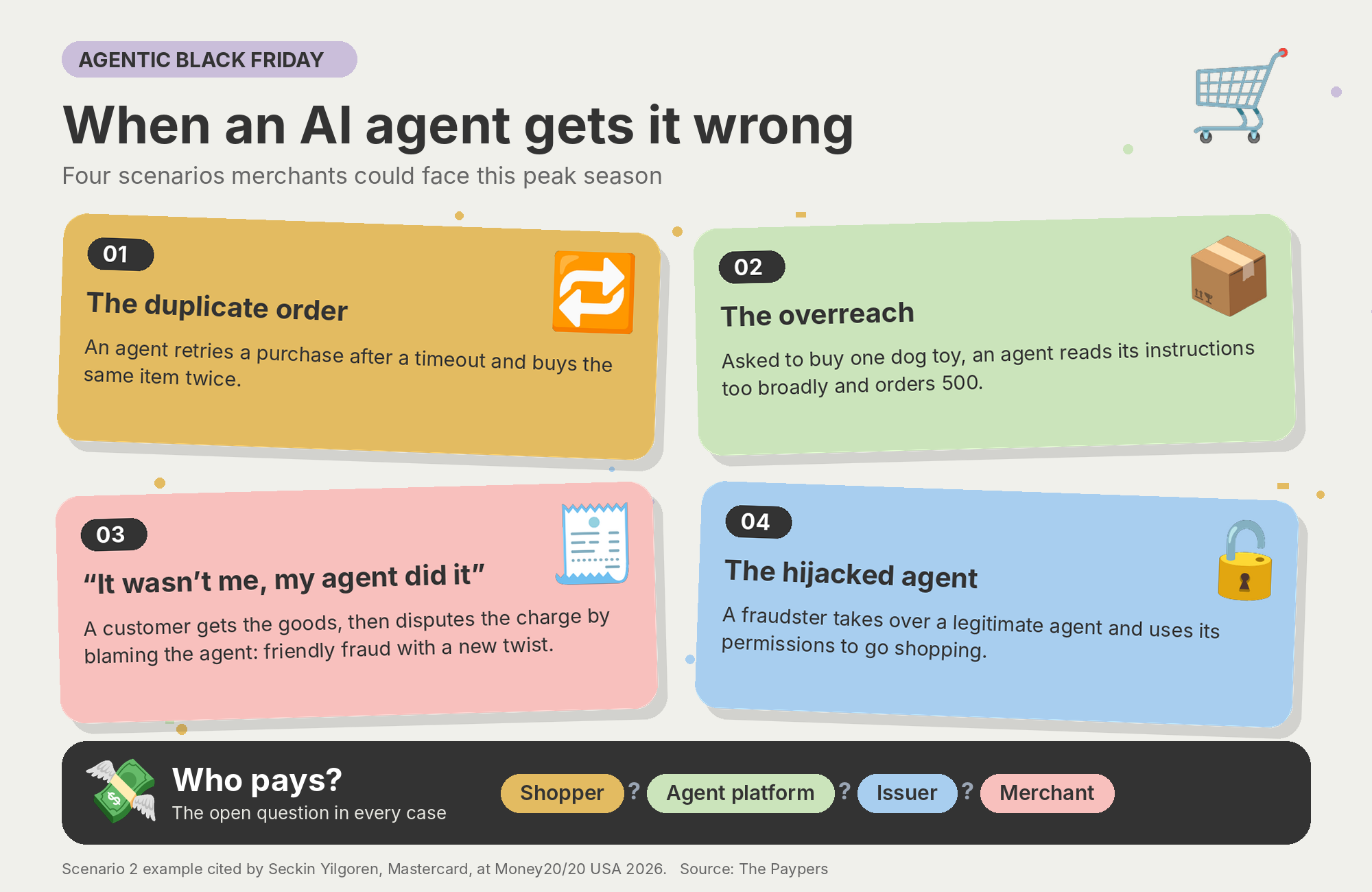
In each case, the question is the same: who pays? Elazar’s answer is blunt:
Chargebacks won’t look like classic identity theft. Expect disputes from customers whose agent bought more than they intended, with unclear liability among the shopper, the platform, and the merchant. Most platforms’ terms make the user liable. In practice, the dispute lands on the merchant. And an authorised agent isn’t necessarily a trustworthy one: a fraud ring can authorise an agent as easily as a loyal customer can. The merchants who cope best will be those who can verify the person behind the agent.
This is the gap EMVCo’s intent framework aims to close: if the consumer’s original instructions can be recorded and retrieved, merchants and issuers have something to check a dispute against. For this Black Friday, however, that evidence trail is largely up to merchants and their partners to build.
The real cost shows up in January
One of the biggest shifts may not be visible on Black Friday. Most merchants focus their peak-season defences on checkout, where fraudsters test stolen cards. Agentic fraud is more likely to surface later, through refunds, returns, and disputes.
According to Riskified, most merchants guard checkout against stolen cards, but far fewer watch refund fraud, return abuse, and promo manipulation, and early signs show agents stripping inventory for resale at a markup. Most of it won’t show up on Black Friday. It shows up in January: more than 55% of January 2026 refund claims in Riskified’s data came from holiday orders.
For fraud and finance teams, that means the real cost of this year’s agentic Black Friday may only become clear after the season ends, when refund claims and chargebacks start coming in.
Preparing for Black Friday
With only weeks to go, experts agree that the goal isn’t to block AI agents altogether or allow them unrestricted access. Instead, merchants need to establish the right level of trust for each one.
For Riskified, the starting point is identity:
Merchants should start with identity. Siloed data and basic bot blockers either miss fraud or decline good customers at peak, so network-level identity linking matters. Agent traffic shouldn’t be treated as one bucket. Policy should vary by who the agent acts for and what it asks to do, approving low-risk orders from verified identities while sending high-risk refund claims to review.
For Lev, merchants should focus on getting the basics of automated payments right:
The main challenge for businesses ahead of Black Friday is not simply allowing AI agents to make purchases, but creating an environment where automated payments are secure, controllable, and convenient for customers. This year, we are not talking about a widespread shift to autonomous shopping. However, companies that begin adapting their payment systems now will be better prepared for the continued development of agentic commerce.
Businesses need to ensure that their systems correctly handle automated purchases, changes to order amounts, repeated requests, and declined payments. It is also important to keep pricing, discount, and product availability information up to date, as AI agents may use this data to select offers independently.
Conclusion
Agentic commerce won’t dominate this Black Friday, but it will be present at enough scale to test how prepared the industry really is. With payment networks still building the rails and standards bodies drafting the rules, much of the risk sits with merchants until liability is clearly defined. Black Friday 2026 may not be the year agents take over the checkout, but it could be the year the industry learns what it takes to let them in safely.
About Paula Albu

Paula Albu has experience in content writing and editing, as well as being a creative storyteller. As a Junior Editor at The Paypers, she investigates Web3 technologies along with the latest trends and regulations in banking and fintech. Paula is committed to turning complex industry topics into engaging, accessible content that resonates with readers and creates a meaningful connection. She is available via LinkedIn or at paula@thepaypers.com.
News on Payments
Expert views on Payments

The Paypers is a global hub for market insights, real-time news, expert interviews, and in-depth analyses and resources across payments, fintech, and the digital economy. We deliver reports, webinars, and commentary on key topics, including regulation, real-time payments, cross-border payments and ecommerce, digital identity, payment innovation and infrastructure, Open Banking, Embedded Finance, crypto, fraud and financial crime prevention, and more – all developed in collaboration with industry experts and leaders.
Current themes


No part of this site can be reproduced without explicit permission of The Paypers (v2.7).
Privacy Policy / Cookie Statement
Copyright