Nick Maynard, VP of Research at Juniper Research, shares why A2A payments struggle with interoperability.
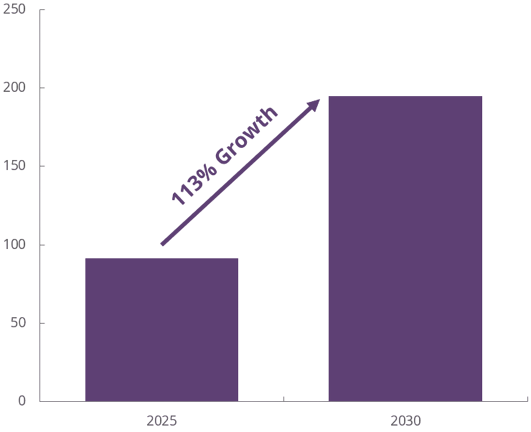
Of all the payments developments we track at Juniper Research, it is hard to find a market which we predict will have a bigger impact than account-to-account (A2A) payments. Providing faster and lower-cost payments at scale, A2A payments are unlocking benefits for existing and new financial services users alike. Indeed, we forecast A2A payments transaction value will reach USD 195 trillion globally in 2030, an 113% increase from 2025.
Figure 1: Global A2A Payments Transaction Value (USD tn), 2025 vs. 2030
Source: Juniper Research
However, while A2A payments are undoubtedly on a growth path, the development is not without challenges, as interoperability is now a major buzzword in payments. Ensuring that systems are interoperable is vital – it’s the difference between initiated payments and actually accepted ones – and for A2A payments, interoperability is a problem. Why is this, what does it involve, and how can the industry fix it?
Why do A2A payments struggle with interoperability?
It is fundamentally important to understand the path to A2A payments developments if we want to uncover why interoperability is challenging. A2A payment systems are typically built domestically and reflect the cultural, technical, and regulatory requirements of each country that builds them. There is an understandably high level of divergence between systems. Consequently, interoperability is not necessarily a given. Often, it’s available internationally only via SWIFT or third-party payment networks, making effective cross-border payments complex.
While we have seen some interoperability efforts, such as Project Nexus in Asia, these typically benefit only regional blocs. Of course, to an extent, some payments, for example in the EU, are harmonised within the shared SEPA framework. However, other payment methods, such as the pan-European digital wallet Wero, are developing across countries at a relatively modest pace. Therefore, the overall state of payments interoperability remains lower than it could be. Even in the Eurozone, interoperability applies only to intra-EU payments. A payment to a non-EU destination often falls short of this interoperable experience.
Why does a lack of A2A payments interoperability matter?
In recent research conducted with cross-border payments specialist Thunes, we found that poor interoperability comes with a real cost. In siloed markets, it traps liquidity and creates delays, with the worst affected being those on the lowest incomes and reliant on remittances.
A lack of interoperability is also a problem for user expectations. Domestic payments have moved quickly in recent years, and users now want payments to be fast, convenient, and secure, which simply makes cross-border payments look worse. As domestic payments offer progressively better experiences, the gap between cross-border payments expectations and reality has increased.
Competition is another challenging aspect. The number of payment methods available to consumers is growing consistently, and several existing and new methods are pursuing interoperability. Cards, for example, are interoperable by design. The EMVCo standards ensure a certain level of commonality, providing a similar experience worldwide. Even digital wallets are increasingly interoperable, as seen with initiatives such as Alipay+ or PayPal World, which are driving interoperability and could significantly alter the market’s direction.
In comparison, A2A payments look out of place due to their lack of interoperability, threatening their growth at a time when they are otherwise very much in the ascendancy. While national governments and regulators look at A2A payment systems as sovereign and highly beneficial to national payment strategies, interoperability must be a primary focus to ensure these systems are as successful as possible.
What can the payments industry do to address the need for interoperability?
At a basic level, the industry needs to acknowledge interoperability as a challenge worth addressing. We need to consider it at the design stage, and regulators and governments must include interoperability-related aspects in their roadmaps.
The wider payments industry is already addressing this. Cross-border specialists are building systems that operate as an additional layer on top of payments, providing simplified connectivity and enabling payments to flow from one system to another. While this improves the user experience, it still cannot change the fact that it differs across payments. As a matter of fact, the consumer payments interaction depends on the corridor it follows, namely the originating and receiving country. This fragmentation is a limiting factor that must be addressed at an A2A scheme level.
The outlook on A2A payments
In the end, it’s all about what kind of payments market we want to see. Currently, despite efforts to the contrary, fragmentation is increasing. As payments become more complex, this challenges the entire ecosystem. Unless key stakeholders, including payments system operators, banks and financial institutions, payments companies, and regulators, agree on interoperability standards, more fragmentation will plague the market.
This editorial piece was first published in The Paypers' Account-to-Account Payments Report 2026, which features insights into global trends, technologies, partnerships, and the next phase of the A2A evolution. Access the full report to understand where the A2A payments ecosystem stands today and what’s next.
About the author
Nick Maynard is VP of Fintech Market Research at Juniper Research. His key focus areas are fintech and payments, including embedded finance, Open Banking, and digital wallets, among others.
About Juniper Research
Juniper Research has been a trusted source of market intelligence to the banking, payments, and anti-fraud sectors for over 20 years. Our fintech and payments research portfolio spans more than 45 reports, covering everything concerning established markets, from QR code payments and virtual cards to fast-evolving technologies, such as CBDCs and stablecoins.