Cross-border payments in 2027: what to watch

Oana Ifrim
20 Nov 2026 / 15 Min Read
As the G20’s end-2027 deadline for faster and cheaper cross-border payments approaches, The Paypers examines the market's dynamics, from US stablecoin regulation and instant payment links to agentic commerce and tokenised deposits. The analysis also looks at how banks, card networks, fintechs, and new entrants are positioning for 2027.
Western Union, founded in 1851 as a telegraph company, launched its own US dollar stablecoin, USDPT, on Solana in May 2026. Six months later, on 10 November, it terminated its agreement to acquire Intermex after California’s Department of Financial Protection and Innovation set final conditions that Western Union said would have required material changes to its business. Intermex has rejected the termination and reserved its rights, including to seek damages.
The two decisions reflect the conditions facing the industry going into 2027. Long-established firms are adopting new settlement technology, while regulators at national and state level have a growing say over how the market consolidates.
The market remains large and is still growing. FXC Intelligence estimates that wholesale and retail cross-border payments were worth USD 208 trillion in 2025, and projects retail flows to grow from USD 44 trillion to USD 67.3 trillion by 2033. The end-user experience has improved far less. The Financial Stability Board’s 2026 progress report, published on 16 November, found that retail cross-border payments became slower over the past year and that sending a USD 200 remittance still costs 5.7% on average.
Key takeaways
- The FSB’s 2026 progress report shows that retail cross-border payments slowed in 2026 and that average retail costs have not fallen since 2023, leaving most of the G20’s end-2027 targets out of reach.
- From 18 January 2027, payment stablecoins in the US can only be issued by approved issuers under the GENIUS Act. Stablecoins carried about 0.31% of retail cross-border flows in 2025, according to FXC Intelligence and Allium.
- Card networks, PSPs, and AI companies are setting the rules for agent-initiated payments. Juniper Research expects agentic commerce to grow from about USD 8 billion in 2026 to USD 1.5 trillion in 2030.
- Industry analysis, including McKinsey’s, suggests that payment execution is becoming a commodity, with providers expanding into treasury, workflow software, and multi-rail orchestration. Regulatory approval is also playing a larger part in which acquisitions go ahead.
- Infrastructure milestones for 2027 include the go-live target for Nexus Global Payments, the expansion of Swift’s retail payments scheme towards around 300 banks, and a tokenised deposit network planned by large US banks.

How autumn 2026 set the agenda for cross-border payments in 2027
Several of the developments that will shape 2027 took place between August and November 2026. On 3 August, Mastercard completed its acquisition of BVNK, a stablecoin infrastructure provider it had agreed in March to buy for up to USD 1.8 billion. The deal gives one of the two largest card networks its own on-chain infrastructure for B2B payments, payouts, and treasury flows, and is one of several moves by incumbents to acquire stablecoin capabilities.
October 2026 put a market price and a rulebook on newer parts of the industry. On 1 October, Airtel Money priced its London IPO at GBP 1.96 a share, valuing the African mobile money business at about GBP 5.3 billion in the largest London listing in five years. On 21 October, the US Office of the Comptroller of the Currency (OCC) finalised its rule implementing the GENIUS Act, which takes effect on 18 January 2027, the same day as the Act itself.
Four further developments followed between 10 and 18 November 2026. Western Union’s termination of the Intermex deal illustrated the role a single state regulator can play in a cross-border transaction; according to Western Union’s regulatory filing, it had approvals from 54 states, territories, and foreign countries. On 13 November, OpenAI launched ChatGPT Wallet with American Express, Mastercard, and Visa, initially for ChatGPT Pro subscribers in the US, letting its agents pay with network tokens after the user approves each purchase. On 16 November, the FSB’s progress report confirmed that the G20 is unlikely to meet its end-2027 targets. On 18 November, Visa extended its Agentic Ready programme to more than 85 acquirers, PSPs, and merchants in Europe, including Adyen, Checkout.com, PayPal, and Stripe, a day after announcing a global expansion to more than 140 acceptance participants.
Market data moved in a different direction from the policy activity. Total stablecoin capitalisation stood at about USD 283 billion on 19 November, according to DefiLlama, down from a peak of roughly USD 311 billion at the end of May. Total supply is an imperfect guide for payments, however, because stablecoins are still used mainly for digital asset trading, with cross-border payments a smaller but growing use.
Cross-border payments trends to watch in 2027
Seven developments are likely to shape cross-border payments in 2027: the G20’s end-2027 deadline for faster and cheaper payments, the start of the US GENIUS Act on 18 January, new links between domestic instant payment systems, the growth of agent-initiated payments, the shift of remittances towards mobile wallets, the parallel development of tokenised deposits and stablecoins, and the growing role of licensing and regulatory approval in market expansion. Each section below sets out the data, dates, and sources behind these developments.
G20 cross-border payments targets: the end-2027 deadline
The G20 endorsed quantitative targets for cross-border payments in 2021, most of them due by the end of 2027. The FSB’s 2026 consolidated progress report finds that the international policy work under the Roadmap is largely complete, but that the results have not reached end users at the scale intended. The Paypers’ explainer on the G20 targets sets out how each target is defined.
|
Measure |
G20 target |
Position in 2026 (FSB) |
|
Retail payments credited within one hour |
75% by end-2027 |
32.9%, down from 34.2% in 2023; 59.8% within one business day, down from 74% |
|
Average cost of retail payments |
1% by end-2027 |
From 1.5% (B2B) to 2.7% (P2P), unchanged since 2023 |
|
Average cost of sending a USD 200 remittance |
3% by 2030 |
5.7%, or 6.2% without the FSB’s exchange-rate rebasing |
|
Wholesale payments on Swift credited within one hour |
75% by end-2027 |
57%, up from 53.8% in 2023 |
Source: FSB, G20 Roadmap for Enhancing Cross-border Payments: Consolidated progress report for 2026, 16 November 2026.
Retail cost range as reported by Payment Expert. Remittance target date from the BIS.
The FSB attributes the shortfall mainly to obstacles at national level. Its survey of authorities found that 48% of responding jurisdictions had data localisation policies in 2026, up from 31% in 2025, and that some licensing regimes for payment providers were set up many years ago and no longer reflect current risks. Almost all G20 members have said they will produce national action plans setting out steps through end-2027, and the FSB will publish a summary of them in early 2027. A peer review of how FSB members apply its 2024 recommendations on payment providers and data frameworks is also scheduled for 2027.
The remittance figure needs context. The FSB says almost all of the decline in the average cost of a USD 200 remittance since 2023 reflects a rebasing of the benchmark amounts in seven countries to account for exchange rate movements; without it, the average would have been 6.2%. The remittance cost target also runs to 2030 rather than end-2027.
How the G20 handles the deadline will be one of the main policy questions of 2027, whether through a new timeline, revised targets, or greater emphasis on national implementation. For providers, evidence that individual corridors already meet the targets is likely to carry more weight with clients and regulators.
US stablecoin regulation: the GENIUS Act takes effect
The GENIUS Act, signed in July 2025, takes effect on 18 January 2027 together with the OCC’s final implementing rule. From that date, payment stablecoins in the US must be issued by approved issuers. The OCC rule covers reserves, redemption, capital, custody, and supervision; anti-money laundering and sanctions requirements will follow in separate rulemaking coordinated with the US Treasury. Issuers with substantially complete applications pending can operate under a waiver of up to 12 months while they are reviewed. In the EU, the stablecoin provisions of MiCA have applied since June 2024.
Companies have taken different approaches ahead of the deadline. Some issue their own tokens: Western Union with USDPT, PayPal with PYUSD (issued by Paxos and available in 70 markets), and Tether with USAT, designed for the US regime. Others acquire infrastructure, as Mastercard did with BVNK. A larger group integrates stablecoins into existing payout and treasury flows through partners, including Convera with Ripple, Payoneer and Veem with Bridge, Nium with Coinbase, and Thunes with Circle, according to FXC Intelligence. In most of these arrangements, the customer sends and receives ordinary currency and the stablecoin is used for settlement in between.
The data points to settlement and treasury as the main near-term uses. FXC Intelligence and Allium estimate that stablecoins carried about USD 135 billion of the USD 44.3 trillion retail cross-border market in 2025, or 0.31%, up from 0.20% in 2024, with the highest share in consumer-to-consumer transfers. Adoption in 2027 is therefore more likely to show up in integrations and settlement volumes than in consumers paying with stablecoins directly.
Instant payment links and local rails: where speed is now decided
Faster international messaging has not removed delays at the receiving end. Swift data cited by Deutsche Bank shows that up to 80% of delays occur after a payment has left the Swift network, on the final stretch to the beneficiary account. The FSB also attributes the recent improvement in wholesale speed to faster crediting by receiving banks. Connections to domestic instant payment systems and widely used local payment methods have consequently become a central competitive factor.
The main public-sector project due in 2027 is Nexus Global Payments, founded in March 2025 by central banks and instant payment system operators from India, Malaysia, the Philippines, Singapore, and Thailand. A joint venture of Malaysia’s PayNet and Singapore’s NETS was appointed as technical operator in February 2026, with go-live targeted for 2027. Instead of building separate bilateral links, each domestic system connects to Nexus once. The FSB reports that the number of fast payment systems planning links with systems abroad doubled over the past year, with planned hub-and-spoke arrangements expected to start operating by 2028.
Private providers are building comparable reach through aggregation. Ant International supports more than 300 payment methods, including over ten national QR systems; Citi offers 24/7 US dollar clearing for institutional clients; and Razorpay tested agent-initiated payments on India’s UPI with NPCI in October 2025. In The Paypers’ Banking View series, Citi’s Ajin Krishnan describes how Australia’s New Payments Platform now extends instant settlement to inbound cross-border payments, so that the domestic leg determines how quickly funds arrive.
Connections between banks and mobile wallets are a growing part of this picture. GSMA’s State of the Industry Report on Mobile Money 2026 found that more than USD 2.1 trillion flowed through mobile money in 2025, including USD 167 billion of bank-to-mobile transfers and USD 163 billion of mobile-to-bank transfers. Cross-border wallet connectivity has developed more slowly. In a TerraPay survey cited in Connected Economies, a report TerraPay published with The Paypers in 2026, 84% of wallet users said they could not send money internationally from their existing wallet, and found that wallets were used for 3.9% of international payments. The report describes how Tigo Money in Bolivia connected to ACCL, the country’s main low-value real-time switch, gaining a single point of access to most local banks instead of building bilateral links with each one. TerraPay co-founder Ani Sane points to the cost of maintaining correspondent relationships: “The reality is that you can’t have an RMA in every country in the world.” The report argues that ISO 20022 gives banks a way to extend their existing connectivity to wallets.
The commercial issue for 2027 is who owns these local connections and on what terms other providers can use them. This applies to banks, PSPs, and wallet operators alike.
Agentic commerce and cross-border payments
AI agents that search for, select, and pay for goods on a user’s behalf moved from pilots towards early products in 2026. Google and Shopify developed the Universal Commerce Protocol, an open standard for agents to transact with merchants. Stripe added agent payments to its Link wallet, and Remitly launched its app inside ChatGPT. Mastercard introduced Agent Suite to help banks and merchants build their own agents, alongside its Agent Pay framework for agent-initiated transactions.
OpenAI’s ChatGPT Wallet, launched on 13 November 2026, uses a transaction-specific network token and requires the user to approve each purchase. It is limited at launch to ChatGPT Pro subscribers in the US with eligible US-issued cards, and OpenAI is working with Adyen, Checkout.com, and Stripe so that merchants’ systems recognise agent-initiated payments. OpenAI’s earlier checkout feature, Instant Checkout, was shelved eight months before the wallet launched, according to FinTech Futures. Visa’s Agentic Ready programme, which began with card issuers and now covers more than 175 issuers in 45 markets, has extended to merchants, acquirers, and B2B platforms. In one B2B pilot, Billtrust reports that agents completed approved invoice payments end to end.
Juniper Research forecasts that agentic commerce will grow from about USD 8 billion of transaction value in 2026 to USD 1.5 trillion in 2030, and identifies low user trust and fragmented local payment methods as the main constraints. Fragmentation matters most in cross-border purchases. An agent buying from an overseas merchant needs a payment method the merchant accepts, a currency conversion, and compliance checks. The provider that supplies those defaults is positioned to earn the FX margin. The indicator to watch in 2027 is the volume of live agent-initiated transactions relative to the number of frameworks announced.
AI is also being applied inside payment companies. Lloyds says 50 generative AI use cases in production generated a GBP 50 million benefit and expects agentic AI to take this to GBP 100 million in 2026, while Payoneer, Flywire, and Tipalti are using AI to automate onboarding, servicing, and back-office work, according to FXC Intelligence. In a low-margin business, these efficiency gains may matter as much as new customer channels.
Remittances and mobile wallets: competition shifts to the receiving end
Mobile wallets have become a main destination for remittances in many receiving countries, which gives wallet operators and the networks connected to them more influence over the corridor. Thunes partnered with MTN MoMo in November 2025 to deliver transfers to recipients in Nigeria, Mastercard Move and Tencent’s TenPay Global partnered in December 2025 to enable remittances into Weixin Pay wallets, and UnionPay International and Visa announced payouts to UnionPay debit cards in mainland China through Visa Direct in February 2026. Earlier, in 2023, Safaricom’s M-PESA connected with TerraPay, enabling more than 32 million M-PESA customers to send money to and receive it from people in Bangladesh and Pakistan, according to TerraPay’s report. Each new link reduces the role of cash pickup and makes the sending brand less visible to the recipient.
Prices continue to fall in the most competitive corridors. The FSB reports that the share of retail corridors costing more than 3% fell to 15.1% in 2026, although not by enough to lower global averages. McKinsey, citing World Bank data, notes that digital-only remittance channels now average below 5%, with the cheapest corridors at or below 3%. Wallet payouts and stablecoin settlement are two approaches that operators with large agent networks are using to lower their costs.
Tokenised deposits and stablecoins: interoperability as the open question
Banks and stablecoin issuers are building parallel forms of on-chain money. Tokenised deposits carry the same regulatory treatment as conventional deposits and keep funds inside the banking system, and the Bank of England has said it prefers banks to develop them rather than stablecoins. UK banks including Lloyds, NatWest, and Barclays have completed the first interbank tokenised deposit transactions, and in the US The Clearing House plans a shared tokenised deposit network for its member banks in the first half of 2027. Swift, meanwhile, is moving its blockchain-based shared ledger, designed to let banks’ tokenised deposits interoperate, from design to implementation.
NatWest’s Lee McNabb has written that tokenisation is unlikely to replace existing infrastructure and that legacy and emerging systems will coexist, which makes interoperability the central requirement. BNY’s Charley Sherman, interviewed for The Banking View at Sibos 2026, takes a similar view: “We believe stablecoins, tokenized money market funds, and tokenized deposits will coexist, and we want our clients to be able to operate across these forms of digital cash, whichever they choose.” He describes BNY using tokenised deposits for round-the-clock payments between its clients and for moving cash margin to clearing houses and exchanges at weekends. The Paypers has covered how institutions are approaching stablecoins, tokenised deposits, and CBDCs as complementary forms of money. For corporate treasurers, the practical question for 2027 is whether bank tokens, stablecoins, and conventional rails can be used interchangeably or will require separate arrangements.
Licensing, acquisitions, and regulatory scrutiny
Licences and charters give providers direct access to accounts, payment systems, and settlement. Providers are pursuing them in every region. In the US, the OCC conditionally approved national trust bank charters for Circle, Ripple, Paxos, BitGo, and Fidelity Digital Assets in December 2025, Revolut has applied for a US banking licence, and Wise has applied for a national trust bank charter. In Asia, EBANX, XTransfer, SUNRATE, TransferMate, and PingPong have obtained licences or approvals in Singapore, Malaysia, or the UAE, and in Africa Flutterwave secured a Nigerian banking licence in April 2026.
Acquisitions remain the faster route to scale. Corpay completed its USD 2.4 billion purchase of Alpha Group at the end of October 2025, Mastercard bought BVNK, Adyen agreed to acquire Talon.One for EUR 750 million, and Payward agreed to buy Reap for USD 600 million. The termination of the Western Union-Intermex deal, which Intermex disputes, shows that state-level approval can now decide the outcome of a transaction. If jurisdictions also update outdated licensing regimes as part of their G20 action plans, entry costs and timelines could change in several markets during 2027.
Who to watch: how the cross-border payments landscape is changing
Cross-border payments no longer divide neatly into banks and fintechs. FXC Intelligence’s 2026 Cross-Border Payments 100 includes banks, card networks, money transfer operators, B2B specialists, merchant acquirers, mobile money providers, ecommerce platforms, and stablecoin firms. Its new entries this year include Tether, Coinbase, Binance, Payward, PhonePe, bKash, GCash, Razorpay, and UnionPay International, which shows how far the field has widened beyond specialist money transfer companies.
This section looks at the main groups of players, how their strategies are changing, and where competition is likely to intensify in 2027. It is not a ranking: the companies named illustrate broader patterns.
Market structure: rising volumes, shrinking margins
Volumes are rising, but the revenue earned on each payment is falling. FXC Intelligence found that take rates fell in every segment of the retail cross-border market between 2022 and 2025, so the revenue pool grew more slowly than flows. McKinsey, which uses a different methodology, estimates that USD 190 trillion crossed borders in 2025, generating about USD 290 billion in revenue, and expects revenues to grow by around 4% a year.
McKinsey’s data also shows how value has shifted between providers. Non-bank providers account for about half of consumer and remittance flows and about a fifth of small and medium-sized business flows. As speed, price transparency, and security become standard, McKinsey argues that moving money is turning from a standalone product into a feature of broader financial and operational services. That shift explains many of the strategic moves described below.
Banks: defending the client relationship
Large banks still handle most wholesale and corporate flows and hold the liquidity behind them, but the economics at the retail end are changing. Several have cut or removed explicit fees on international transfers: McKinsey cites KBC’s commission-free multicurrency wallet, Bank of America’s waiver of outbound wire fees on transfers sent in foreign currency, and HSBC’s fee-free global money transfers, which earn revenue mainly from FX spreads. Other banks embed specialists such as Wise in their own apps.
Swift’s payments scheme is the banks’ collective response. Its rulebook commits participating banks to upfront fees and FX rates, full-value delivery, and end-to-end tracking, with a focus on the final leg of the payment. More than 60 banks from 25 countries are taking part in the first phase, and Swift reported in September that over 30 institutions were already processing payments across more than 40 corridors linking 19 countries. Bank of America and JPMorgan Chase are among the US adopters.
Large banks are also issuing their own on-chain money. JPMorgan says its Kinexys platform has processed more than USD 3 trillion since launch, HSBC launched a tokenised deposit service for corporate clients in 2025, and Citi and Standard Chartered run comparable services, according to FXC Intelligence.
Contributors to The Paypers’ Banking View series frame the challenge in terms of relationships. TD Securities’ Andrew Breslin and Anthony Zheng argue that the main risk for banks is losing ownership of the client relationship to fintechs and payment specialists, while BNY’s Bana Akkad Azhari contends that banks need to prove resilience across multiple rails before optimising for cost.
Card networks: from card rails to multi-rail networks
Visa and Mastercard are positioning themselves as networks that connect many forms of money to many endpoints. Visa Direct pays out to UnionPay debit cards in mainland China and, since January 2026, lets overseas Filipinos move funds from their Visa cards into GCash wallets. Mastercard Move delivers to Weixin Pay wallets. Both networks are adding stablecoins: Mastercard through BVNK, and Visa by supporting stablecoin-linked card issuance in more than 50 countries and piloting Visa Direct payouts to stablecoin wallets.
The networks are also setting the early standards for agent-initiated payments through Visa’s Agentic Ready programme and Mastercard Agent Pay. Current agent payment products, including ChatGPT Wallet, run on network tokens, existing fraud tools, and established dispute rules. Mastercard, Visa, and Stripe took the top three places in Juniper Research’s 2026 ranking of payment infrastructure providers for agentic commerce.
Money transfer operators: digital channels and stablecoin settlement
Established money transfer operators are adapting their models as prices fall and digital-first providers gain share. Western Union describes its stablecoin as part of a move to a digital-first operating model, with USDPT initially used for settlement with agents and partners and first rolled out in the Philippines and Bolivia. DefiLlama data showed about USD 19 million of USDPT in circulation on Solana in early November, six months after launch. Euronet has built stablecoin rails with Fireblocks for treasury and partner settlement and reported 35% growth in digital transactions in the first quarter of 2026, while MoneyGram has expanded stablecoin-based services in Latin America.
Digital remitters are widening their product range. Remitly, led by Sebastian Gunningham since February 2026, plans to take a larger share of consumer payments, and Zepz, the owner of WorldRemit and Sendwave, acquired US card and lending company Pomelo in January 2026. The Intermex case also illustrates the regulatory scrutiny that acquisitions of consumer-facing businesses can attract.
Scaled fintechs: from payment specialists to financial platforms
Fintechs that won share on price and speed over the past decade are building broader businesses, often with banking licences. Wise added a Nasdaq listing in May 2026 alongside its London listing. Revolut, which passed 70 million customers in May 2026, has applied for a US banking licence, and its chief executive said in April that an IPO was still two years away. Airwallex says it serves more than 250,000 businesses, added regulated capabilities in 12 new markets in 2025, and plans to invest USD 1 billion in the US between 2026 and 2029. Ebury raised GBP 550 million in April 2026, including from its majority shareholder Santander.
McKinsey identifies four strategic directions for payment specialists. Some, such as Airwallex and Tipalti, are becoming business operations platforms that embed payments into accounts payable, invoicing, and expense management. Others, such as Ebury, are moving towards a transaction banking model with accounts, liquidity, and FX risk management. A third group specialises in sectors where the payment is one step in a longer process, as Flywire does in education, and a fourth orchestrates multiple rails for other providers, as Thunes and Nium do. In each case, revenue increasingly comes from the services around the payment.
Global payroll shows how the sector-specialist model is developing. Deel, which holds payment licences in several jurisdictions, launched stablecoin salary payouts in May 2026, and Papaya Global processes around USD 34 billion of payroll a year across more than 180 countries.
Infrastructure providers and emerging-market specialists
A less visible group of companies sells cross-border reach to other providers. Thunes says its network connects to more than 15 billion cards, 8 billion bank accounts, and 4 billion mobile and stablecoin wallets. TerraPay says it holds 32 licences and regulatory approvals and that 97% of payments on its platform complete in under 60 seconds. Banking Circle gives banks and payment companies direct access to clearing in multiple countries and gained access to Switzerland’s SIC system in February 2026. Their clients are banks, money transfer operators, and fintechs that prefer not to build global infrastructure themselves.
Emerging-market specialists are expanding beyond their home regions. dLocal passed USD 1 billion in revenue in 2025, with total payment volume up 60% to USD 41 billion, and supports more than 900 local payment methods. EBANX opened an Asia-Pacific headquarters in Singapore and announced expansion into Thailand, Indonesia, Malaysia, Vietnam, and Turkey in 2026. In Africa, Onafriq is piloting the continent’s first wallet-based outbound payments corridor, from Nigeria to Ghana, with the Pan-African Payment and Settlement System. Asia-based B2B platforms such as XTransfer, PingPong, LianLian Global, and SUNRATE are adding licences in Southeast Asia and the Middle East. McKinsey notes that US-China trade fell by about 12% in 2025, with much of it redirected to ASEAN economies, which helps explain the push into the region.
New entrants: stablecoin firms, crypto platforms, and AI companies
Digital asset companies account for most of the new names. Circle runs the Circle Payments Network, which lets banks and payment companies settle in USDC; Thunes uses its managed service so that customers benefit from stablecoin settlement while dealing only in fiat currency. Payward, the parent of Kraken, agreed in May 2026 to buy Reap in a deal valuing Payward at USD 20 billion, and Fireblocks reports processing around USD 200 billion of stablecoin volume a month for more than 300 payment providers, fintechs, and banks.
Regulation is bringing several of these firms closer to the banking system through the OCC trust charters and the GENIUS Act. Tether launched USAT for the US regime alongside USDT, which, according to FXC Intelligence, does not comply with it. DefiLlama data shows about USD 179 million of USAT on Ethereum in mid-November; USDT, in circulation since 2014, stood at about USD 175 billion across all chains.
AI companies form the newest category. ChatGPT Wallet runs on card network tokens rather than on a new payment rail, so the product relies on the card networks, issuers, and PSPs that OpenAI works with. Whether AI platforms develop their own payment relationships with users, or remain a distribution layer on top of existing rails, is an open question for the coming years.
Regional champions and super apps
In many receiving markets, the domestic wallet is becoming the main endpoint for incoming money. bKash reported more than 82 million customers at the end of 2025 and receives remittances from 135 money transfer operators in more than 170 countries; GCash says 94 million Filipinos have used its app; M-PESA serves more than 60 million customers across Africa. Senders increasingly compete on how directly they can pay into these wallets.
Several of these platforms are expanding outward. Ant International, spun out of Ant Group in 2024, says it supports more than 300 payment methods and averages more than 20 million transactions a day. PhonePe received in-principle approval for a payments licence in the UAE in September 2026, although its domestic IPO has been on hold since March. Airtel Money, with 56.5 million customers and an annualised transaction value of about USD 245 billion as of June 2026, is now separately listed in London. Mercado Libre has concentrated its stablecoin efforts on Meli Dollar in Brazil, Mexico, and Chile.
Competitive dynamics to watch in 2027
Partnerships are becoming more common than direct displacement. Banks embed fintech services, card networks pay into wallets they once competed with, and stablecoin firms sell settlement to incumbents. Competition is shifting towards control of the customer interface and the data, while more of the underlying infrastructure is shared.
Consolidation is likely to continue as margins narrow and compliance costs rise, a point McKinsey also makes. The Intermex case suggests that deal timelines and conditions, especially for consumer-facing businesses, will be harder to predict.
The newest entrants depend on incumbents for distribution. Stablecoin issuers need banks, PSPs, and wallets to reach end users, and AI agents currently pay over card rails. How far these firms build their own customer relationships, rather than supplying infrastructure to others, is one of the main open questions for 2027.
Outlook: five developments likely to shape 2027
- The G20 is more likely to extend or reframe its targets than to abandon them, given that almost all members have committed to national action plans running through end-2027.
- Stablecoin growth in payments is likely to come mainly from settlement, treasury, and payout flows, where the end customer often does not hold a stablecoin.
- Card networks are likely to carry most agent-initiated payments in the near term, because current agent payment products rely on network tokens, existing fraud tools, and established dispute rules.
- Regulatory review is likely to weigh more heavily on acquisitions in remittances and consumer payments, particularly in the US, after the Intermex outcome.
- Wallet payouts are likely to keep gaining share in remittance delivery, as senders and networks add direct links to GCash, bKash, M-PESA, and similar platforms.
What the changes mean for banks, PSPs, remittance providers, and corporates
- Banks: Swift’s payments scheme addresses the transparency and last-mile issues that fintech competitors have used to win retail and SME customers. Tokenised deposit initiatives, including The Clearing House network planned for 2027, will determine whether bank money can be used in the same settlement flows as stablecoins. As TD Securities argues in the Banking View series, banks that modernise slowly risk handling the final leg of a payment without owning the client relationship.
- PSPs and acquirers: Visa’s Agentic Ready acceptance phase and Mastercard Agent Pay set out how agent-initiated transactions will be recognised and processed. Merchants are likely to ask providers how they distinguish legitimate agents from fraudulent automated traffic.
- Remittance providers: direct payout links into wallets such as GCash, bKash, M-PESA, and Weixin Pay, combined with stablecoin settlement in suitable corridors, are the main levers for bringing costs closer to the 3% target set for 2030.
- B2B payments and FX providers: with execution margins under pressure, value is moving to treasury, FX risk management, and workflow integration. Licences remain important but costly to obtain, which makes market selection a strategic decision.
- Merchants and corporates: questions worth putting to providers in 2027 include whether they can settle in stablecoins or tokenised deposits on request, whether they accept agent-initiated payments, and what a cross-border payment costs in total once FX spreads are included.
Key dates for cross-border payments in 2027
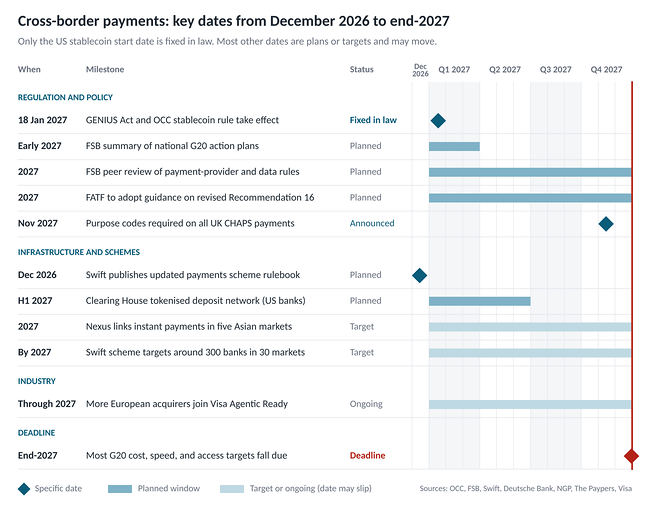
Sources: OCC final rule, FSB progress report (FSB, FATF, and Bank of England dates), Deutsche Bank (Swift scheme), The Paypers (The Clearing House), Nexus Global Payments, Visa.
Only the 18 January start date for the GENIUS Act is set in law. The Nexus go-live and Swift’s expansion are targets, and the FSB and FATF dates are plans that may move.
Two listings are also worth monitoring. PhonePe’s IPO has been on hold since March 2026, and Revolut’s chief executive said in April 2026 that its planned flotation was still two years away.
Frequently asked questions about cross-border payments in 2027
The answers below summarise key facts from this article, drawn from sources including the FSB, FXC Intelligence, McKinsey, Juniper Research, and Nexus Global Payments. They reflect information available on 20 November 2026.
Will the G20 meet its 2027 cross-border payments targets?
Most targets are unlikely to be met by end-2027. The FSB’s 2026 progress report shows that 32.9% of retail payment services credit recipients within one hour, against a target of 75%, and that average retail costs have not fallen since 2023.
When does the GENIUS Act take effect?
The GENIUS Act and the OCC’s implementing rule take effect on 18 January 2027. From that date, payment stablecoins in the US must be issued by approved issuers.
How big is the cross-border payments market?
FXC Intelligence estimates the combined wholesale and retail market at USD 208 trillion in 2025, including USD 44 trillion of retail flows. It projects retail flows to reach USD 67.3 trillion by 2033. McKinsey, using a different methodology, puts 2025 flows at USD 190 trillion.
What share of cross-border payments uses stablecoins?
About 0.31% of retail cross-border flows in 2025, or roughly USD 135 billion of USD 44.3 trillion, according to FXC Intelligence and Allium. The share was 0.20% in 2024.
What is agentic commerce, and why does it matter for cross-border payments?
Agentic commerce refers to AI agents finding and paying for goods or services on a user’s behalf. In cross-border purchases, the agent must handle currency conversion, local payment methods, and compliance, which creates a new point of competition for payment providers. Juniper Research forecasts agentic commerce spending of USD 1.5 trillion by 2030.
What is Nexus Global Payments?
Nexus Global Payments is a scheme founded by central banks and payment system operators from India, Malaysia, the Philippines, Singapore, and Thailand to connect domestic instant payment systems through a single platform. Go-live is targeted for 2027.
Outlook for 2027
The G20 is likely to miss most of its end-2027 targets, but several components needed to improve cross-border payments are moving into place: a federal stablecoin framework in the US, links between domestic instant payment systems, a common rulebook for retail payments over Swift, and bank-led tokenised deposit networks. None of them covers the whole payment chain on its own. The providers most likely to benefit in 2027 are those that can connect these systems for their customers while absorbing rising compliance costs and lower margins on each transaction.
About the author

Oana Ifrim is Lead Editor and Writer at The Paypers. After more than a decade at The Paypers, Oana has built a pretty good sense of what’s happening across banking and fintech, with a strong network of industry insiders across payments, digital innovation, regulation, fraud, and financial crime. She mixes content strategy, trend spotting, a (slightly obsessive) love of research, expert conversations, and a big dose of curiosity to turn complex industry shifts into engaging stories and thought leadership that bring a little life to the industry’s biggest conversations.
More recently, she has been deeply dedicated to The Banking View, an exclusive series bringing direct perspectives from banking leaders on how they’re navigating payments modernisation, fraud and financial crime, regulation, and innovation.
When Oana is out of office, you’ll probably find her singing, reading, cooking with her family, getting happily lost in detective and mystery shows, or exploring every forest she can find with her husband and daughter.
If you’d like to exchange ideas, explore content opportunities, or there’s an industry topic you’d love to dig into, reach out to her at: oana@thepaypers.com or on LinkedIn.
News on Payments
Expert views on Payments

The Paypers is a global hub for market insights, real-time news, expert interviews, and in-depth analyses and resources across payments, fintech, and the digital economy. We deliver reports, webinars, and commentary on key topics, including regulation, real-time payments, cross-border payments and ecommerce, digital identity, payment innovation and infrastructure, Open Banking, Embedded Finance, crypto, fraud and financial crime prevention, and more – all developed in collaboration with industry experts and leaders.
Current themes


No part of this site can be reproduced without explicit permission of The Paypers (v2.7).
Privacy Policy / Cookie Statement
Copyright